


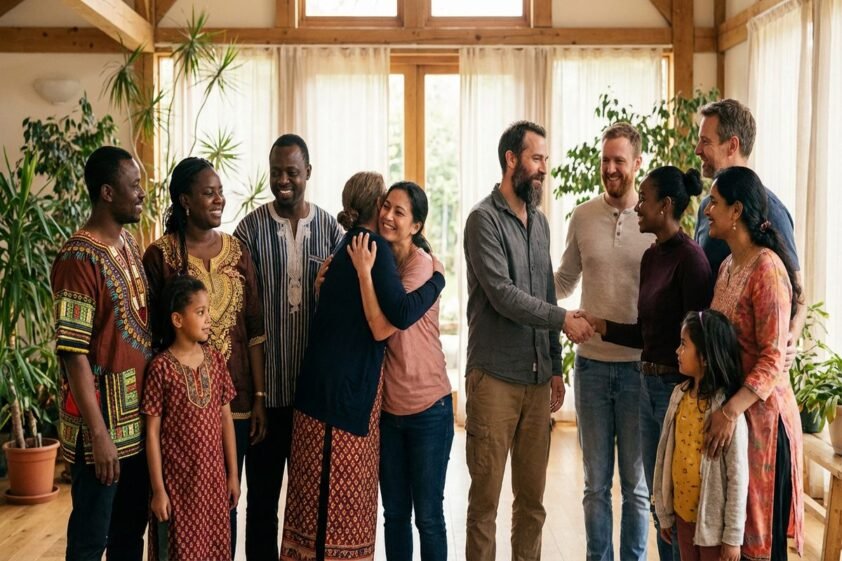
In an increasingly interconnected world, the concept of assimilasjon has become a focal point for understanding how societies evolve. The term, originating from Norwegian, describes the process by which individuals or minority groups gradually adopt the customs and attitudes of the prevailing culture, leading to a more homogeneous social landscape.
This phenomenon, while a constant throughout human history, carries complex implications for identity, heritage, and social harmony in our modern, globalized communities.
The Core of Assimilasjon: More Than Just Fitting In
At its heart, the discussion around assimilasjon revolves around choice and pressure. Voluntary assimilation is often a natural process, where individuals willingly adapt to a new culture to gain social or economic advantages.
In contrast, forced assimilation involves coercive policies and societal pressure designed to erase minority cultures, a practice that has left deep scars on communities worldwide.
It is also crucial to distinguish assimilasjon from similar concepts. While assimilation often implies a one-way street where a minority culture is absorbed by the dominant one, integration promotes a two-way process.
In an integrated society, individuals can participate fully in the broader community while still preserving their unique cultural identity. Multiculturalism takes this a step further, celebrating the coexistence of diverse cultures within a single society.
| Aspect | Assimilation | Integration |
|---|---|---|
| Cultural Identity | Original culture is replaced | Original culture is maintained |
| Language | Heritage language is often lost | Bilingualism is encouraged |
| Social Outcome | Cultural homogeneity | Hybrid and dual identities |
| Psychological Impact | Higher stress and identity conflict | Better mental health and self-esteem |
A Look Back: Assimilasjon in History
History is replete with examples of assimilation, both voluntary and forced. Ancient empires, such as Rome, spread their language and customs throughout their vast territories.
During the colonial era, European powers often imposed their cultural norms on indigenous populations, leading to the suppression of local languages and traditions.
In Norway, the policy of “fornorskingspolitikken” (Norwegianization policy) from the 19th and 20th centuries serves as a stark reminder of forced assimilation. This policy targeted the indigenous Sámi people and other minorities, such as the Kven and Romani communities.
Through measures like banning the use of minority languages in schools, the state actively sought to erase their cultural identities. Today, these policies are widely condemned, and efforts are underway to revitalize these once-suppressed cultures.
The Many Faces of Assimilasjon: Types of Cultural Change
Assimilation is not a monolithic process; it unfolds across several dimensions of an individual’s life. Cultural assimilation is the most visible form, involving the adoption of the dominant culture’s language, dress, and social customs.
Structural assimilation occurs when minority groups gain access to the core institutions of a society, such as education, employment, and political representation.
Other forms include linguistic assimilation, where a new language is adopted, and identificational assimilation, a deeper shift in self-perception that can take generations to unfold.
These different facets of assimilation often occur at different paces, creating a complex and often challenging journey for those navigating between cultures.
The Human Side of Assimilasjon: Psychological Impact
The process of assimilation can have a profound impact on an individual’s psychological well-being. The pressure to adapt to a new culture can lead to acculturative stress, a form of culture shock that can manifest as anxiety, depression, and a sense of alienation.
This is particularly true in cases of forced assimilation, where individuals may feel a deep sense of loss and identity conflict.
Interestingly, research has uncovered what is known as the “immigrant paradox.” This refers to the finding that individuals who successfully blend their heritage culture with their new culture—a state known as biculturalism—often report higher self-esteem and better mental health outcomes than those who fully assimilate or remain isolated from the new culture.
This suggests that maintaining a connection to one’s roots is a crucial component of a healthy adaptation process.
Assimilasjon Today: Challenges and Opportunities
In contemporary multicultural societies, the debate around assimilation continues. Proponents argue that a shared culture is necessary for social cohesion and national unity.
Critics, however, contend that assimilation can lead to the loss of valuable cultural heritage and place undue pressure on minority groups to conform.
The benefits of successful integration are clear, including greater economic opportunities and improved social mobility. However, the challenges are equally significant.
Even when individuals fully assimilate, they may still face discrimination and prejudice, highlighting the deep-seated nature of societal biases.
The Path Forward: Embracing Integration and Hybrid Identities
In recent years, there has been a noticeable shift away from assimilationist policies towards models of integration and multiculturalism. Many societies now recognize that cultural diversity is a strength, not a weakness.
The focus has moved towards creating inclusive communities where individuals can participate fully without having to sacrifice their cultural identity.
Ultimately, the future of cultural adaptation lies in finding a balance between preserving heritage and fostering social unity. By embracing hybrid identities and promoting a two-way process of cultural exchange, societies can build a more inclusive and harmonious future for all.