

The Enduring Power of a Brief Narrative
In the vast world of literature, some of the most profound stories are the shortest. Kate Chopin’s “The Story of an Hour,” penned in the late 19th century, stands as a testament to this truth. In just over a thousand words, it explores a universe of emotion and thought.
This brief narrative has captivated readers for generations. It offers a powerful glimpse into the inner life of a woman constrained by the world she inhabits, and the shocking, fleeting moment of her liberation.
A Glimpse into Louise Mallard’s World
We are introduced to Louise Mallard as a woman defined by her fragility. Her “heart trouble” is the first thing we learn, suggesting a physical weakness that mirrors the delicate position of women in her era.
Yet, this condition is more than a medical diagnosis. It serves as a powerful metaphor for her suppressed spirit and the emotional confinement she experiences within her marriage and society.
The Moment of Awakening
From Grief to Liberation
Upon hearing the news of her husband’s death, Louise reacts with the expected sorrow. She weeps, fulfilling the role of the grieving wife that society has scripted for her.
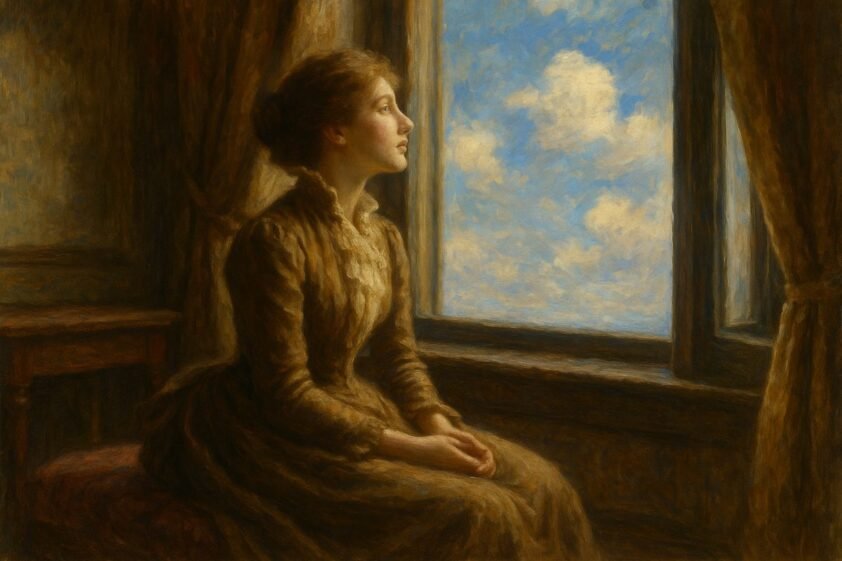
But as she retreats to her room, something unexpected begins to stir. Through her window, she observes the world outside, full of life and promise, and a new awareness starts to dawn.
“Free, Free, Free”
The whispered words escape her lips almost involuntarily: “free, free, free.” This is the heart of the story, the moment her personal truth breaks through the surface of convention.
What follows is not sadness, but a “monstrous joy.” She envisions a future that belongs entirely to her, a life where her own will is her guide. It is a powerful, exhilarating, and forbidden taste of independence.
Symbols That Speak Volumes
The Open Window
The open window in her room is a central symbol. It is her portal to a world of possibility, a clear view into the life she could lead, unburdened and unrestricted.
Through it, she sees the blue sky, hears the distant song, and feels the breath of rain. These are all signs of a new life, a rebirth into a world of freedom.
The Heart
Louise’s heart carries a dual meaning. It is the source of her physical weakness, the very thing that makes her seem so fragile to those around her.
But it is also the seat of her deepest desires, the core of her being that yearns for autonomy. Ultimately, it is this heart that cannot bear the return to a life of confinement.
The Crushing Weight of Irony
The story’s climax is a masterpiece of situational irony. The front door opens, and her husband, Brently Mallard, walks in, alive and completely unaware of the tragedy he was thought to be a part of.
In the final, devastating twist, Louise dies. The doctors conclude she died from “the joy that kills,” believing she was overjoyed to see her husband alive. But the reader knows the truth: she died from the sudden, crushing loss of her newfound freedom.
Marriage and Identity in the 19th Century
To fully grasp Louise’s experience, one must understand the context of her time. In the 19th century, marriage was often an institution that subsumed a woman’s identity into her husband’s.
Even in a kind marriage, like the one Louise seems to have had, a woman’s independence was secondary. Her life was defined by her role as a wife, not as an individual with her own dreams and desires.
Why “The Story of an Hour” Still Matters
Over a century later, Chopin’s story continues to resonate. It speaks to the universal human desire for self-determination and the quest for a personal identity.
While the societal constraints have changed, the core themes of finding oneself and the struggle for autonomy remain deeply relevant in our modern world.
A Story for the Ages
“The Story of an Hour” is more than just a piece of feminist literature. It is a timeless exploration of the human spirit’s yearning to be free.
It reminds us that a single hour can contain a lifetime of revelation, and that the loss of a dream can be as fatal as any physical ailment.