



Is guest posting a relic of a bygone SEO era, or is it still a golden ticket to the top of Google? The internet is awash with conflicting advice, leaving many marketers wondering if it’s a strategy worth pursuing. Let’s cut through the noise. Guest posting absolutely still works in 2026, but the game has changed entirely. Forget the old, spammy tactics; today’s success hinges on a new set of rules.
This guide will provide a clear, no-nonsense roadmap to making guest posting a powerful part of your SEO arsenal. We’ll move beyond the outdated advice and focus on what Google truly rewards today: quality, relevance, and genuine value.
Why the “Guest Posting is Dead” Myth Won’t Die
The declaration that “guest posting is dead” echoes through SEO forums every year, yet the strategy persists. This myth is rooted in the evolution of guest posting itself. A decade ago, it was a numbers game. Marketers would churn out low-quality articles for any site that would take them, stuffing them with keywords and exact-match anchor text links. The goal was quantity over quality, and for a while, it worked.
Then came Google’s Penguin update and the more recent, sophisticated SpamBrain AI, which Google explicitly mentions in its documentation on link spam. These algorithm updates were designed to penalize manipulative link schemes and thin content. The old way of guest posting — the spammy, low-effort approach — was officially dead. What survived, and what thrives today, is a strategy focused on providing genuine value on reputable, relevant websites.
The key distinction is this: it’s not guest posting that died. It’s the abuse of guest posting. That’s a critical difference, and understanding it is the first step to using the strategy effectively.
The New Rules: How to Win at Guest Posting in 2026
To succeed with guest posting now, you must align your efforts with Google’s core principles. It’s no longer about simply acquiring a link; it’s about earning it by demonstrating quality and authority.
Focus on E-E-A-T
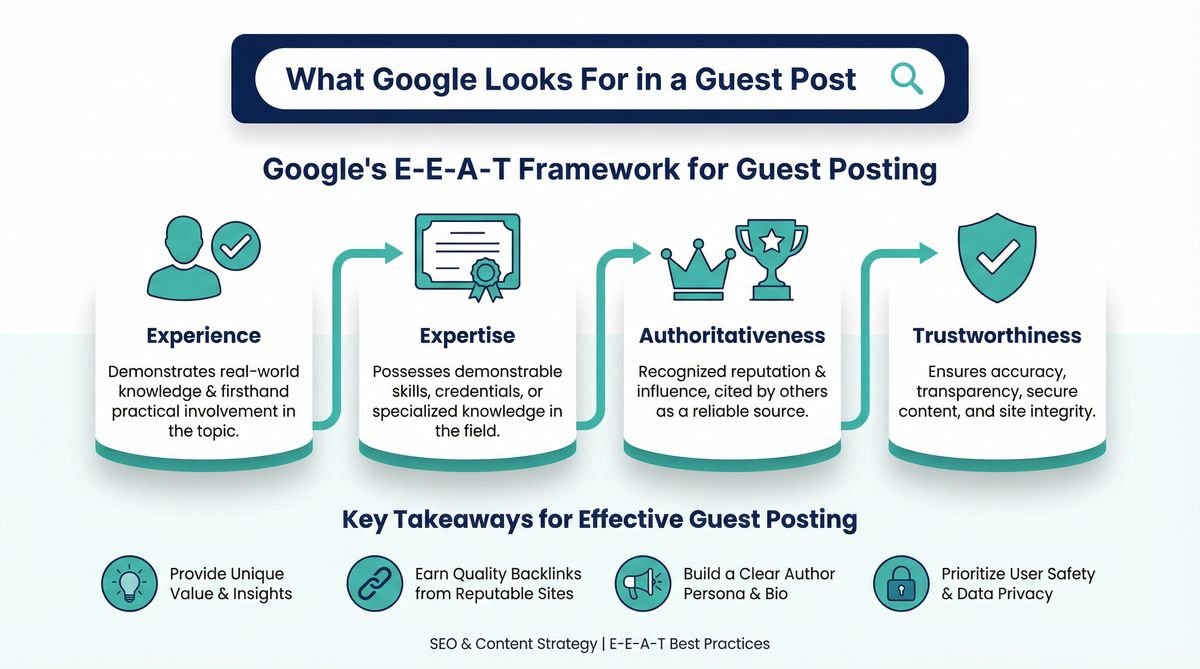
Google’s Quality Rater Guidelines emphasize E-E-A-T: Experience, Expertise, Authoritativeness, and Trustworthiness. A successful guest post must embody these principles. This means going beyond generic content. Share original data, offer a unique perspective based on your hands-on experience, and back up your claims with credible sources. Your author bio should also be robust, clearly stating who you are and why you’re qualified to speak on the topic.
Build Topical Authority, Not Just Links
Instead of one-off posts on random high-DA sites, think in terms of topic clusters. A series of related guest posts on authoritative sites within your niche signals to Google that you are an expert on that specific subject. This helps you build topical authority, which can lead to higher rankings for a whole group of related keywords, not just the one you linked to.
Prioritize Relevance Over Domain Authority
While Domain Authority (DA) can be a useful metric, it’s not the be-all and end-all. A link from a highly relevant, niche-specific blog with an engaged, albeit smaller, audience can be far more valuable than a link from a generic, high-DA news site. Relevance sends a powerful signal to Google that your link is a genuine editorial endorsement, not a paid placement.
Your Step-by-Step Guide to High-Impact Guest Posting
Executing a successful guest posting campaign requires a systematic approach. Here’s how to do it right, from finding opportunities to writing content that earns lasting results.
Step 1: Finding the Right Opportunities
Forget endless Google searches for “your niche + write for us.” The best opportunities are often hidden. Try competitor backlink analysis using tools like Ahrefs or Semrush to see where your competitors are getting their links. If a site has linked to them, they might be open to a well-crafted pitch from you. Another effective method is to find sites that regularly feature expert interviews in your industry — these sites are already looking for authoritative voices.
Step 2: The Perfect Pitch (Template Included)
A generic, templated email is the fastest way to get your pitch deleted. Personalization is key. Here is a ready-to-use template that focuses on providing value to the site owner, rather than just asking for a favor:
Subject: Content Idea for [Site Name]
Hi [Editor’s Name],
I’m a huge fan of [Site Name] and particularly enjoyed your recent article on [Specific Article]. Your point about [Specific Point] was spot on.
I’ve been working in [Your Niche] for [Number] years, and I’ve noticed a gap in the conversation around [Your Topic]. I think your audience would get a lot of value from an article on this, and I’ve put together a detailed outline.
Would you be open to me sending it over for you to take a look?
Best,
[Your Name]
[Link to your site or portfolio]
Step 3: Writing Content That Gets Noticed
Once your pitch is accepted, the real work begins. Your content must be exceptional — better than what’s already on the host site. Include unique data, create custom visuals, and provide actionable advice. When it comes to your link, make sure it’s placed naturally within the content where it adds genuine value to the reader, rather than being shoehorned in at the end.
Guest Posting vs. Digital PR vs. Link Inserts: Which is Best?
Understanding the nuances between different link-building tactics is crucial for allocating your resources effectively. Many marketers treat these strategies as interchangeable, but they serve distinct purposes and carry different risk profiles. Here’s a clear comparison to help you decide where to invest your efforts.
| Tactic | Best For | Cost / Effort | Risk Level | SEO Impact |
|---|---|---|---|---|
| Guest Posting | Building topical authority and a foundational link profile | Medium | Low–Medium | High |
| Digital PR | Acquiring high-authority links from top-tier publications | High | Low | Very High |
| Link Insertions | Quickly acquiring a link on an existing, relevant page | Low–Medium | Medium–High | Medium |
Guest posting occupies a sweet spot: it’s more scalable than digital PR and carries less risk than link insertions when done correctly. For most businesses building a long-term SEO strategy, it remains the most balanced option.
The Ultimate Site Vetting Checklist: 7 Red Flags to Avoid
Not all guest posting opportunities are created equal. Placing a link on the wrong site can actively harm your SEO. Before you invest time and effort into a pitch, run the potential site through this checklist.
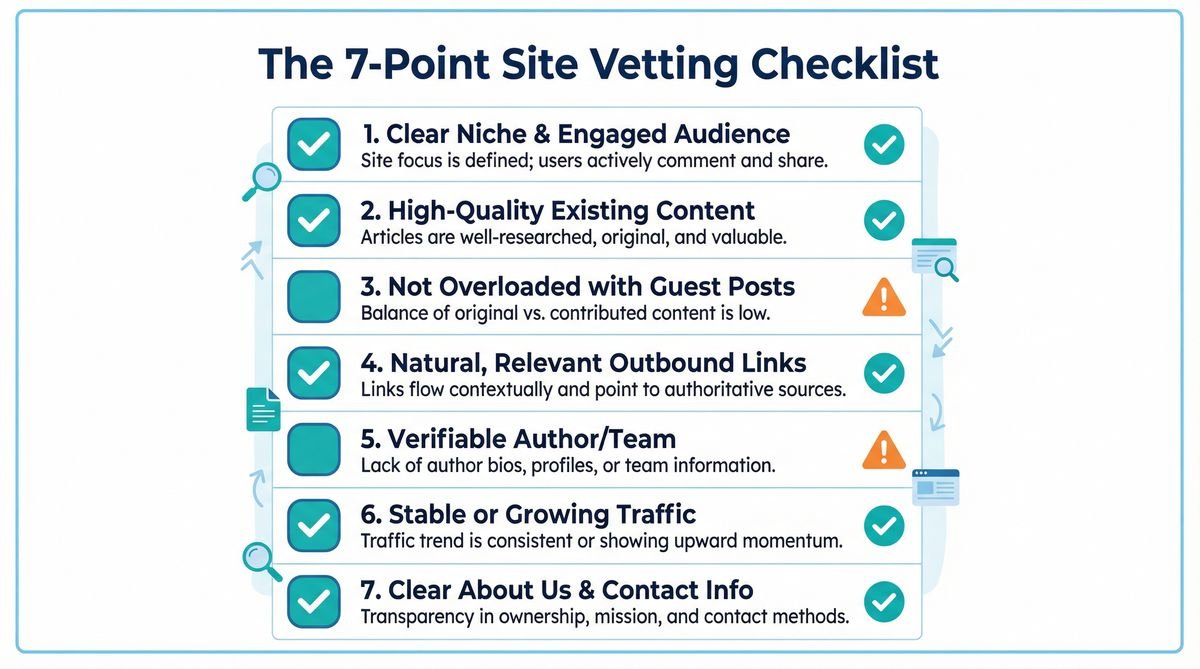
- Does the site have a clear niche and an engaged audience? Look for comments, social shares, and a consistent content focus. A site that covers everything from recipes to cryptocurrency is a red flag.
- Is the existing content high-quality and well-edited? Poor grammar, thin content, and factual errors are major warning signs about the site’s editorial standards.
- Does the site publish an excessive number of guest posts? A blog that’s 90% guest posts might be a link farm in disguise. Legitimate sites maintain a healthy balance of original and contributed content.
- Are outbound links relevant and natural? If every article links out to casinos, payday loan sites, or other unrelated industries, the site’s link profile is likely toxic.
- Does the site have a real, verifiable author or team? Anonymous blogs lack the transparency that Google’s E-E-A-T guidelines reward. Look for real names, bios, and social profiles.
- What is the site’s traffic trend? Use a tool like Ahrefs or Semrush to check organic traffic. A site with steadily declining traffic is a sinking ship — a link from it will provide diminishing returns.
- Does the site have a clear “About Us” and contact information? Legitimate businesses are easy to contact and transparent about who they are. If you can’t find this information, proceed with extreme caution.
Frequently Asked Questions
Is guest posting still good for SEO in 2026?
Yes, absolutely. When done correctly — focusing on high-quality content on relevant, authoritative sites — guest posting remains a highly effective strategy for building authority, earning valuable backlinks, and driving referral traffic. The key is to approach it as a value-creation exercise, not a link-acquisition scheme.
Can I use AI to write my guest posts?
While AI can be a useful tool for brainstorming and outlining, relying on it to write the entire post is a significant risk. Google’s systems are increasingly effective at detecting AI-generated content, and a lack of genuine experience and expertise — the first “E” in E-E-A-T — is a major red flag for both Google and human editors. Use AI as an assistant, not a replacement for your own expertise and voice.
How many guest posts should I aim for per month?
Quality trumps quantity, every time. Instead of aiming for a specific number, focus on securing one or two high-quality placements per month on sites that are genuinely relevant to your niche. A single, well-placed guest post on a top-tier site is worth more than ten posts on low-quality blogs, both for SEO and for your brand’s reputation.
What’s the difference between a nofollow, sponsored, and follow link in a guest post?
A follow link is a standard link that passes SEO value (or “link juice”) from the host site to your site. A nofollow link carries a rel="nofollow" attribute, telling Google not to pass direct SEO value, though it can still drive referral traffic. A sponsored link uses the rel="sponsored" attribute and is required for any paid placement — like nofollow links, it does not pass direct SEO value but is essential for transparency and compliance with Google’s guidelines.
How do I measure the ROI of my guest posting efforts?
Track four key metrics over time: referral traffic (how many visitors arrive from the guest post), keyword rankings (did your target keywords improve after the link was placed), conversions (are those visitors becoming leads or customers), and brand mentions (has the post led to an increase in your brand being cited elsewhere online). Together, these metrics paint a clear picture of whether your guest posting strategy is delivering real business value.
Conclusion: The Verdict on Guest Posting in 2026
Guest posting hasn’t died; it has evolved. The days of churning out low-quality articles for any site with a pulse are long gone, and good riddance. Success in 2026 and beyond hinges on a strategic approach centered on quality, relevance, and providing genuine value to the reader — not to the search engine.
By focusing on building topical authority, demonstrating your E-E-A-T, carefully vetting your opportunities, and crafting personalized pitches, guest posting remains one of the most powerful and sustainable strategies for building your brand’s authority and driving long-term organic growth. With the right approach, it’s not just a viable tactic — it’s a genuine competitive advantage that your competitors are likely underutilizing.
External References: Google Search Central: Link Spam Policy | Google Search Quality Rater Guidelines