
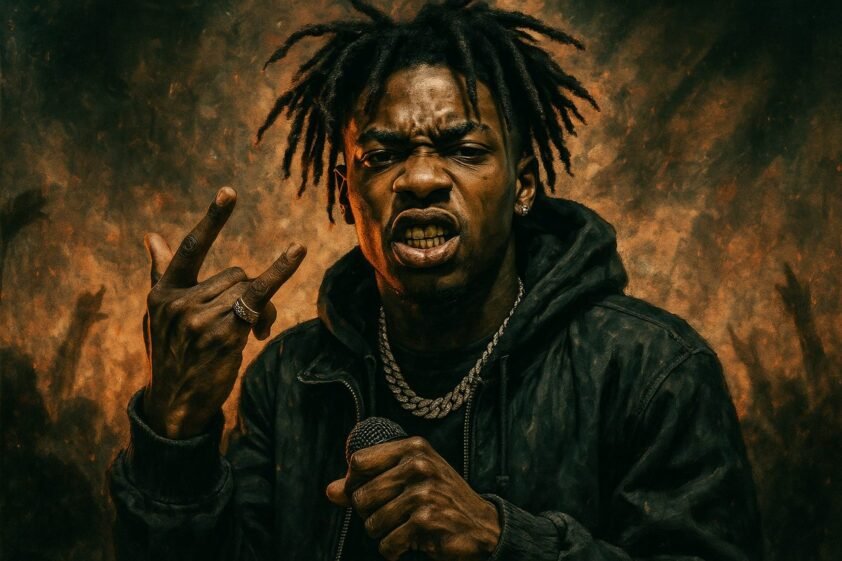
In the whirlwind of modern hip-hop, where trends appear and vanish in the blink of an eye, few albums have managed to truly disrupt the system. Playboi Carti’s debut studio album, Die Lit, is one of those rare exceptions. Dropped like a bomb on May 11, 2018, it was a masterclass in organized chaos, a project that didn’t just follow the rules of trap music—it rewrote them.
Die Lit was more than an album; it was a cultural reset. It solidified Playboi Carti as a true original and unleashed a sound that would echo through the next generation of hip-hop.
The Unpredictable Arrival of a Modern Classic
Forget the lengthy teasers and calculated marketing schemes. Die Lit arrived with the subtlety of a lightning strike, its surprise release sending a jolt through the music community.
This guerrilla-style drop only added to the album’s mystique. It forced everyone to experience the music on its own terms, raw and unfiltered. The iconic cover—a grainy, black-and-white shot of Carti suspended in air as he dives into a sea of fans—was the perfect visual metaphor for the punk-rock, anti-establishment energy contained within.
Crafting the Sound of a Generation
The sound of Die Lit is its very soul. It’s a beautiful paradox: minimalist in its approach, yet incredibly complex in its layering. This unique sonic identity was born from the almost telepathic connection between Carti and his main producer, Pi’erre Bourne.
The Genius of Pi’erre Bourne’s Production
As the architect behind 15 of the album’s 19 tracks, Pi’erre Bourne is the unsung hero of Die Lit. His beats are a dizzying blend of glitched-out synths, seismic 808s, and sounds that feel like they were ripped from a parallel dimension’s video game arcade.
Pitchfork famously described his work as a concoction of “hacked Game Boys, busted subwoofers, and chopped and screwed snippets of Ratatat records.” Bourne’s talent lies in his ability to weave these chaotic threads into a vibrant, cohesive tapestry of sound.
Carti’s Ad-Lib Heavy Revolution
Floating over Bourne’s otherworldly production is Carti’s one-of-a-kind vocal delivery. He treats his voice less as a tool for storytelling and more as another instrument in the mix. His signature ad-libs—the “what’s,” “slatt’s,” and “bih’s”—are not just background noise; they are the hooks, the main attraction.
This “post-verbal” style, combined with his now-iconic high-pitched “baby voice,” creates a hypnotic and immersive experience. It’s a sound that’s more about feeling the energy than dissecting the lyrics.
A Star-Studded Guest List
While Carti and Bourne are the undeniable heart of the album, Die Lit is sprinkled with a perfectly chosen cast of collaborators. Each guest steps into Carti’s world, adding their own color to the canvas without ever painting over his vision.
Skepta’s gritty verse on “Lean 4 Real” provides a perfect contrast to Carti’s ethereal flow, while Lil Uzi Vert’s appearance on “Shoota” feels like a victory lap for the new school of rap. With other features from heavyweights like Travis Scott, Nicki Minaj, and Young Thug, the album is a celebration of hip-hop’s diverse and forward-thinking landscape.
The Critical Reception: A Divisive Masterpiece
When Die Lit first landed, it split the room. Some critics immediately recognized its brilliance, while others were left scratching their heads. Pitchfork championed it with a rare 8.5/10 score, calling it a “perversely infectious sugar high.”
Others were not so convinced, acknowledging its infectious energy but questioning its substance and longevity. This polarization was, in itself, a sign of the album’s disruptive power. It wasn’t made to please everyone; it was made to push boundaries. For those who were on its wavelength, it was a revelation.
The Enduring Legacy of Die Lit
Years later, the shockwaves of Die Lit are still being felt. The album has evolved from a cult favorite into a genuine cultural phenomenon, a key reference point for the sound of modern trap.
From Cult Favorite to Cultural Cornerstone
The album’s influence is everywhere. Its sound has been absorbed and reinterpreted by a legion of new artists, cementing its status as one of the most important hip-hop records of its time. It challenged the definition of “mumble rap” and proved that true innovation often comes from breaking the mold entirely.
Online communities still buzz with discussion about the album. For many fans, it’s not just Carti’s best work; it’s one of the greatest trap albums ever created, a project that permanently rewired their musical DNA.
The Album That Never Gets Old
Perhaps the most telling sign of Die Lit‘s greatness is its incredible replay value. The album sounds as fresh and futuristic today as it did on the day of its release. It’s a timeless body of work that feels at home in any setting.
This lasting appeal is a testament to its masterful execution. The blend of hypnotic production and pure, unadulterated energy creates an experience that listeners can’t help but return to, a soundtrack to countless memories.
Conclusion: More Than Just an Album
Die Lit is not just a collection of tracks. It’s a landmark artistic statement, a snapshot of a moment when the rules of hip-hop were bent and broken. It’s the sound of youthful rebellion, of creative freedom, of a sugar high that you never want to end.
Playboi Carti and Pi’erre Bourne didn’t just make an album; they created a world. And it’s a world that music fans will be getting lost in for many years to come.