
Isles of the Emberdark. What exactly is this mysterious new world, and how does it fit into the grand, ever-expanding tapestry of the Cosmere?
This latest novel from the prolific Brandon Sanderson is more than just a standalone story. It is a bold, genre-bending expansion of his beloved novella, Sixth of the Dusk, propelling the narrative into a far-future setting that feels both familiar and startlingly new.
It serves as a crucial bridge, showcasing the vast, cosmic scale that the author has been building toward for decades. The book masterfully blends the primal magic of a remote planet with the advanced, star-faring politics of a galactic civilization.
The Emberdark Beckons: A New Chapter in the Cosmere
The core conflict of Isles of the Emberdark is rooted in a desperate race against time. The protagonist, Dusk, must find a way to protect his people on the planet First of the Sun from the encroaching threat of the “Ones Above.”
These invaders from the stars seek to exploit the planet’s unique resource: the Aviar, supernatural birds that grant their bonded partners extraordinary abilities. The stakes are existential, forcing a traditional society to confront a terrifyingly modern problem.
The novel is a powerful exploration of cultural survival. It asks whether a people can embrace necessary change without sacrificing the very essence of who they are.
From Novella to Novel: The Evolution of Dusk’s Story
The Foundation: Sixth of the Dusk
The story begins with the foundation laid in the 2014 novella, Sixth of the Dusk. It introduced readers to Dusk, a trapper on the deadly island of Patji, who survives by bonding with the Aviar.
The novella was a contained, atmospheric tale of survival and discovery. It hinted at a larger universe but remained firmly grounded in the unique ecosystem of First of the Sun.
Five Years Later
Isles of the Emberdark picks up the thread roughly five years after the events of the original story. Dusk’s initial success in defending his people has only bought them a little time.
The pressure to modernize is immense, and the cultural cost is high. The novel deftly uses flashbacks to the novella’s events, ensuring that new readers are not lost while enriching the experience for long-time fans.
This expansion allows Sanderson to delve deeper into the political and technological fallout of First of the Sun’s first contact with the wider Cosmere.
Navigating the Stars and the Soul: Core Themes
The narrative is rich with philosophical depth, particularly in its examination of knowledge and progress. Two themes stand out as central to Dusk’s journey.
The Power of Storytelling
Dusk’s people rely on oral tradition, a method of history-keeping that is mocked as primitive by the more technologically advanced “aliens” he encounters.
Yet, the novel ultimately validates the power of these stories. It suggests that belief and shared narrative can be a force as potent as any advanced technology.
It is a subtle but profound commentary on the reliability of history and the strength found in cultural identity.
Technology vs. Tradition
The path to salvation seems to lie in acquiring advanced technology from the Cosmere. However, Dusk learns that true protection comes from understanding his own world.
The story argues that progress should not necessitate the abandonment of heritage. It is a delicate balance between embracing the future and honoring the past.
Dual Perspectives: Dusk and Starling
The novel employs a dual narrative structure, giving readers two distinct windows into this complex world.
Dusk: The Grounded Protagonist
Dusk remains the emotional anchor of the story. His grit, his connection to the land, and his fierce loyalty to his people make him a compelling and relatable hero.
He represents the struggle of the individual against overwhelming cosmic forces. His journey is one of personal sacrifice for the sake of his entire civilization.
Starling: The Dragon in Human Form
The second viewpoint introduces Starling, a dragon forced into a human guise. She is a fascinating character, a pilot deep in debt and part of a ragtag crew.
Starling’s perspective provides the necessary lens into the galactic scale of the conflict. Her story is one of exile, debt, and a desperate search for a lucrative discovery that leads her to Dusk.
The Cosmere Connection: Deep Lore and Future Implications
Isles of the Emberdark is set so far into the Cosmere’s future that it functions almost as a standalone science fantasy novel. Yet, for those invested in the lore, the book is a treasure trove.
It is littered with deep references and huge implications for the future of the entire universe. The presence of Scadrians and Rosharans, though far removed from their origins, signals the growing interconnectedness of the planets.
The story ventures into the Cognitive Realm, here called the Emberdark, and hints at the “destructive echo of a dead god.” These elements confirm the novel’s importance in setting the stage for the next major era of the Cosmere.
Final Verdict: A Standalone Epic with Cosmic Weight
The book is a triumph of pacing and character work. Sanderson has a natural ability to get readers invested in his characters from the very first page.
The narrative builds steadily, leading to the author’s famous climax, the “Sanderlanche,” which is executed with thrilling precision. It is a non-stop, all-hands-on-deck rush to the finish.
Isles of the Emberdark is a fantastic, great stand-alone novel. While Cosmere veterans will find immense payoff in the deep lore, any reader looking for an inventive, emotional science fantasy epic will be thoroughly satisfied.
The Art of the Book: A Visual Masterpiece
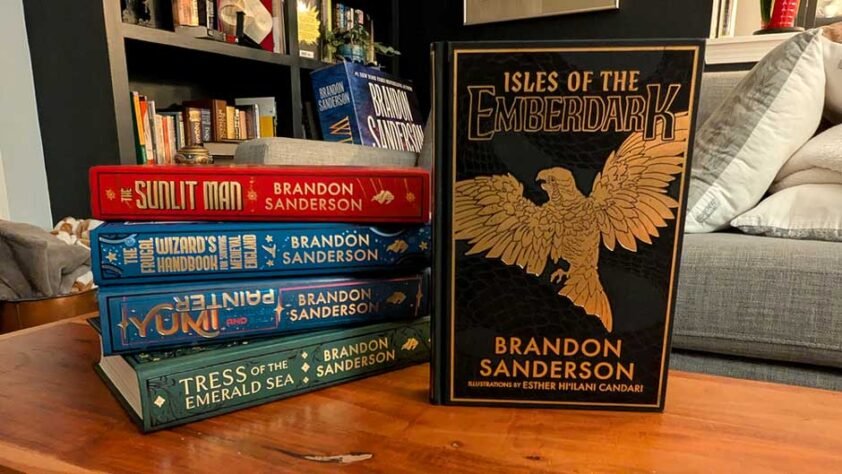
Beyond the narrative, the physical edition of the book is a work of art. The black trim work on the pages and the embossed cover make it a stunning collector’s item.
It is a testament to the care and detail put into the Secret Projects. The visual presentation matches the epic scope of the story within its pages.