

Introduction
Have you ever seen a flash of brilliant blue and rust against the muted greens of a Western forest? If so, you may have just witnessed the Western Bluebird (Sialia mexicana), a small but captivating thrush that brings a splash of color to the American West.
These charming birds are a common sight in open woodlands and parklands, often perching on low wires or fence posts before darting down to the ground. Their presence is a vibrant indicator of a healthy, diverse ecosystem.
A Closer Look: Western Bluebird Identification
Distinguishing the Male and Female
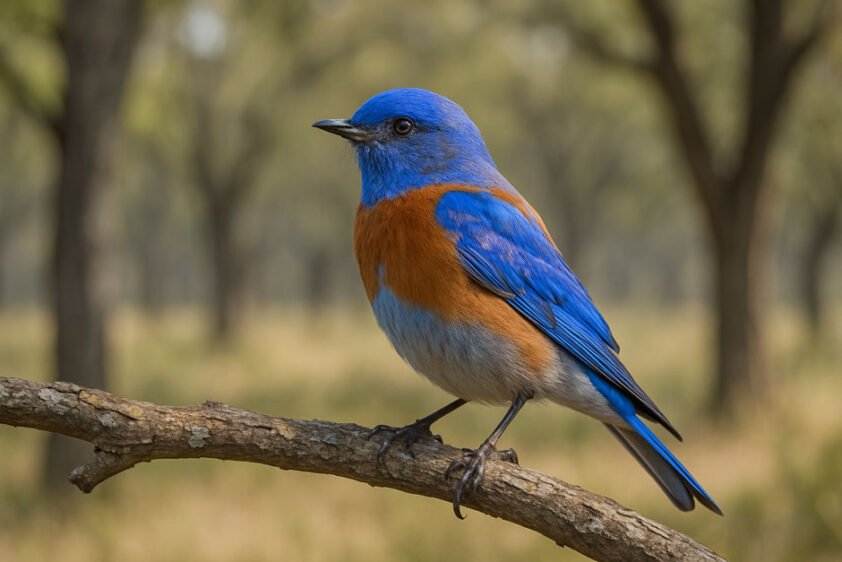
The male Western Bluebird is a truly striking sight. His head, back, and wings are a deep, luminous blue, contrasting sharply with a rusty-orange breast and sides.
This vibrant plumage is a key identifier. The female, while still beautiful, is noticeably duller, sporting a grayer body with only a tinge of blue on her wings and tail, and a paler orange wash on her breast.
Size and Appearance
As a member of the thrush family, the Western Bluebird is a stocky bird, measuring between six and a half to seven and a half inches long. They possess a thin, straight bill perfect for snatching insects.
Despite their small size, weighing only about an ounce, they are robust and often perch upright, giving them a confident, alert posture as they scan the ground for their next meal.
Where the Bluebirds Roam: Habitat and Range
Preferred Environments
The ideal home for the Western Bluebird is not a dense forest, but rather open, scattered woodlands and edges. They thrive in areas like oak savannahs and ponderosa pine forests.
These open habitats provide the perfect balance: scattered trees for nesting cavities and perching, and grassy clearings for foraging on the ground.
Geographic Distribution
Their range extends across much of the Western United States, stretching from the Rocky Mountains westward to the Pacific coast. They can be found as far north as British Columbia and south into central Mexico.
While some populations are migratory, many Western Bluebirds are resident year-round, particularly in the milder coastal and southern parts of their range.
The Bluebird’s Menu: Diet and Foraging
Insectivorous Summer Diet
During the breeding season, the Western Bluebird is primarily an insectivore. Their diet consists of a variety of invertebrates, including grasshoppers, beetles, caterpillars, and spiders.
They employ a distinctive “flycatching” technique. The bird will sit patiently on a low perch, then suddenly drop to the ground to snatch an unsuspecting insect before returning to its lookout.
Winter Berries and Fruits
As the weather cools and insects become scarce, the bluebird’s diet shifts. They begin to rely heavily on small fruits and berries, such as mistletoe, juniper, and elderberries.
This seasonal change allows them to survive the colder months and highlights their adaptability in finding sustenance throughout the year.
Home Sweet Home: Nesting and Reproduction
The Importance of Cavities
Western Bluebirds are secondary cavity nesters. This means they cannot excavate their own nest holes and must rely on existing cavities created by woodpeckers or natural decay in dead trees.
The availability of these suitable nest sites is a critical factor in their population health, which is why they readily take to human-provided nest boxes.
Social Dynamics and Helpers
Their family life can be surprisingly complex. Some nests have “helpers”—extra birds, often the young from a previous brood, that assist the parents in feeding the new nestlings.
Interestingly, studies have shown that not all young are fathered by the resident male, indicating a dynamic social structure within the breeding pairs.
Fascinating Facts and Behavior
Territory Battles and Temperament
Despite their gentle appearance, territory battles can be intense. Rival males have been observed grabbing each other’s legs and tumbling to the ground in fierce disputes.
The winner will often pin his opponent and jab at him with his bill, a surprising display of aggression from such a small bird.
Lifespan and Weight
A Western Bluebird weighs only about 28 grams, roughly the weight of a few coins. They require about 15 calories per day to maintain their energy, or more when raising young.
The oldest known individual lived to be at least eight years and eight months old, a testament to their resilience in the wild.
Supporting the Western Bluebird
Providing Nest Boxes
One of the most effective ways to help these birds is by placing species-appropriate nest boxes in suitable habitats. This directly addresses the shortage of natural nesting cavities.
The boxes should be placed in open areas near scattered trees, well before the start of the breeding season, to encourage their use.
Offering Mealworms
While they primarily forage for wild insects, Western Bluebirds can be attracted to backyard feeders by offering live or dried mealworms.
This can be a crucial supplement during periods of cold or when natural insect populations are low, allowing bird enthusiasts to enjoy their presence up close.
Frequently Asked Questions (FAQ)
What is the difference between a Western Bluebird and an Eastern Bluebird?
The most noticeable difference is the plumage pattern. The Eastern Bluebird has a solid blue back and a full rust-colored breast. The male Western Bluebird has a blue back, but the rust color often extends up the sides and sometimes onto the back, creating a more complex pattern.
Where do Western Bluebirds build their nests?
They build their nests inside existing tree cavities, old woodpecker holes, or human-made nest boxes. They line these cavities with fine grasses, pine needles, and sometimes hair or feathers.
What do Western Bluebirds eat?
In the summer, their diet is mainly insects, which they catch by dropping from a low perch to the ground. In the winter, they switch to a diet of small berries and fruits.
Are Western Bluebirds endangered?
No, the Western Bluebird is not considered endangered. While some local populations have faced challenges due to habitat loss and competition for nest sites, their overall population is stable, and they are classified as a species of Least Concern.
Why is the Western Bluebird’s blue color so vibrant?
The blue color is not due to a pigment. Instead, it is a structural color caused by the way light interacts with the microscopic structure of the barbs in their feathers. This structure scatters blue light, making the bird appear brilliantly blue.