

In the uneasy peace following World War I, a shadow fell over the United States. It wasn’t the threat of a foreign army, but a pervasive, unsettling fear from within. This period, the nation’s first “Red Scare,” saw widespread panic over Bolshevism and anarchism ignite a series of aggressive government actions that would scar the nation’s commitment to its own ideals.
At the heart of this conflict were the Palmer Raids, a direct and brutal response to the era’s social and political turmoil. They forced a confrontation between national security and individual liberty, drawing battle lines that are still debated in conversations about freedom today.
A Nation Gripped by Fear
The end of World War I was supposed to usher in an era of peace. Instead, it plunged the United States into a turbulent transition defined by economic anxiety, explosive labor unrest, and a gnawing fear of foreign ideas.
The 1917 Russian Revolution had sent tremors across the world, and a paranoid America began to see revolutionaries in every shadow. This anxiety was amplified by a wave of intense labor strikes and the violent racial conflicts of the “Red Summer” of 1919, creating a perfect storm for anti-radical hysteria.
The Red Scare and Post-War Anxiety
The air in post-war America was thick with suspicion. Soldiers returned home not to parades, but to a grim reality of scarce jobs and soaring inflation that squeezed every household. In the search for a scapegoat, many pointed fingers at the growing immigrant populations and those with radical political beliefs.
Seizing on this mood, the government passed laws like the Sedition Act of 1918. This act didn’t just punish actions; it criminalized opinions deemed disloyal to the United States, forging the legal weapon that would soon be used to crush dissent.
The Spark: Anarchist Bombings of 1919
The simmering fear of radicalism finally exploded in the spring and summer of 1919. A coordinated campaign of mail bombs targeted prominent politicians, judges, and titans of finance. The terror reached its peak on June 2, when bombs detonated in eight cities at once.
The most prominent target was the nation’s top law enforcement officer, Attorney General A. Mitchell Palmer, whose Washington, D.C. home was partially demolished. Palmer and his family escaped injury, but the bomber was killed instantly. For Palmer, the fight was now personal.
The Architect: Attorney General A. Mitchell Palmer
A. Mitchell Palmer, a politician with a keen sense of opportunity, saw the attack as his moment. He cast himself as the nation’s defender against the creeping menace of radicalism, launching a crusade to purge the country of subversives.
To spearhead this campaign, Palmer created a new intelligence division within the Bureau of Investigation—the forerunner to the FBI. To run it, he chose a young, ambitious, and meticulous lawyer named J. Edgar Hoover, whose task was to build a vast index of radical groups and their members.
The Palmer Raids: A Campaign of Mass Arrests
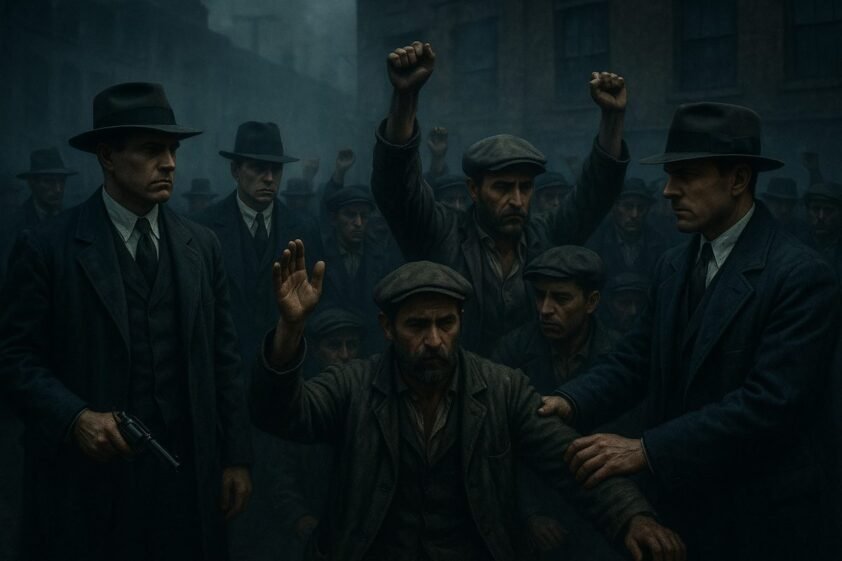
With Hoover’s intelligence guiding them, Department of Justice agents launched their first major assault in November 1919. But this was just a prelude. On January 2, 1920, they unleashed a coordinated dragnet across 33 cities, arresting thousands of suspected anarchists and communists in a single night.
These raids were executed with brutal efficiency and a flagrant disregard for the law. Agents, often acting without warrants, arrested thousands of immigrants based on nothing more than their political leanings or associations. The objective was clear: arrest first, ask questions later, and deport as many as possible.
The Human Cost: Violations of Civil Liberties
The Palmer Raids descended into a shocking spectacle of civil liberties violations. Individuals were dragged from their homes and workplaces, subjected to beatings, and held for weeks without ever speaking to a lawyer.
Stories of the abuse were rampant. In one infamous case, federal agents stormed a community center and brutally beat an algebra teacher in front of his students. The raids fostered a chilling atmosphere where the mere suspicion of holding the wrong opinion could lead to a prison cell.
The Backlash and Palmer’s Downfall
Though the raids were initially met with public approval, the sheer scale of the abuses soon sparked a powerful backlash. A growing chorus of prominent lawyers, judges, and civil rights advocates began to publicly condemn Palmer’s tactics.
Palmer’s downfall was sealed by his own hubris. He breathlessly predicted a massive, violent communist uprising on May Day of 1920. When the day passed peacefully, Palmer became a national laughingstock, and his presidential aspirations evaporated overnight.
The Legacy of the Palmer Raids
The Palmer Raids ultimately failed in their stated goal. No grand revolutionary conspiracy was ever uncovered, and only a small fraction of the thousands arrested were ever deported. Yet, their impact on American history was profound and enduring.
In direct response to the government’s flagrant disregard for the Constitution, a new organization was born in 1920: the American Civil Liberties Union (ACLU). The raids remain a stark cautionary tale of how easily a nation’s fear can be weaponized, and how quickly the principles of freedom can be sacrificed in the name of security.