


An Elegy Born from Tragedy
In 1865, as the American Civil War drew to a close, the nation found itself caught between celebration and sorrow. The joy of a preserved Union was shattered by the assassination of President Abraham Lincoln.
From this crucible of national emotion, Walt Whitman, a poet who aimed to be the voice of America, crafted “O Captain! My Captain!” The poem became an immediate and deeply personal elegy for a fallen leader.
The Ship of State: A Powerful Metaphor
The Captain and His Vessel
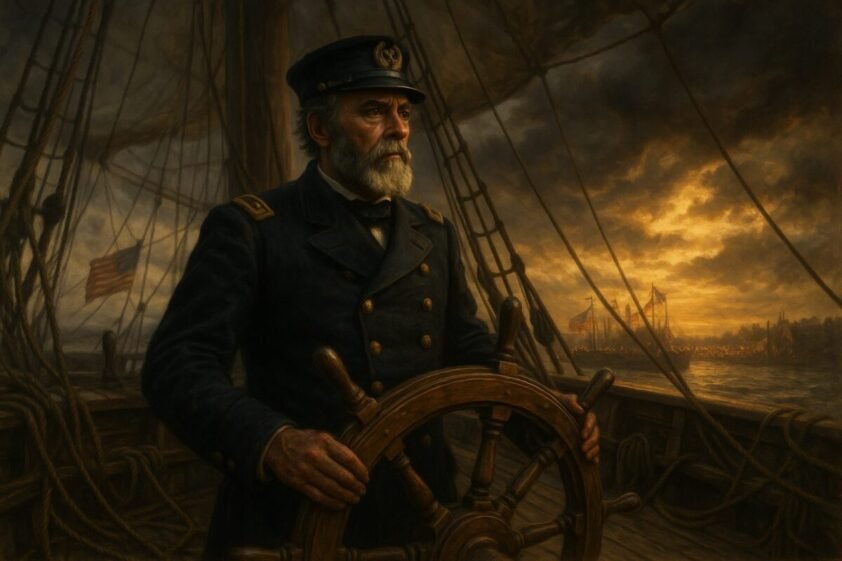
To capture this complex moment, Whitman turned to a powerful and familiar image: the ship of state. In this extended metaphor, the United States is a vessel that has just completed a “fearful trip,” the Civil War.
At its helm is the Captain, Abraham Lincoln, the steady hand who guided the nation through the storm. This imagery allowed Americans to grasp the magnitude of their loss; the leader who had brought them safely to shore was not there to celebrate the victory.
A Nation’s Perilous Journey
The poem paints a vivid picture of the nation’s journey. The “prize we sought is won,” referring to the preservation of the Union, but the victory feels hollow.
The sight of the harbor and the sound of exulting crowds on the shore represent the peace the nation longed for. Yet, this scene of triumph is tragically overshadowed by the Captain lying “cold and dead” on the deck.
A Study in Contrasting Emotions
The true genius of “O Captain! My Captain!” lies in its dramatic tension. Whitman masterfully juxtaposes the public joy of victory with the intensely private pain of loss.
The poem’s speaker, a sailor on the ship, sees the flags, hears the bugles, and watches the cheering crowds. Yet he cannot join them. His reality is the quiet, personal grief for his fallen commander.
This clash between collective celebration and individual mourning creates a powerful emotional resonance. It captures a universal truth about loss: even in moments of shared triumph, personal sorrow can feel isolating.
A Surprising Shift in Style
What surprises many who study Whitman is the poem’s traditional style. Known as the father of free verse, Whitman set aside his usual rule-breaking form for a structured, rhyming, and rhythmic poem that feels almost like a song.
This was a deliberate choice. The poem’s simple, accessible structure made it easy for a grieving public to embrace. It became Whitman’s most famous and recited work during his lifetime, offering a shared voice for a nation’s sorrow.
The Enduring Cultural Impact
A Lasting Tribute
“O Captain! My Captain!” was instantly popular and widely anthologized, securing its place in American culture. It was a poem that resonated with everyone, from schoolchildren to scholars.
Ironically, its immense popularity was a source of some frustration for Whitman, who felt it overshadowed his more experimental work. Still, its power as a tribute to a revered leader was undeniable.
A Poem for the Ages
The poem’s legacy extends far beyond the 19th century. It found new meaning for generations mourning other fallen leaders and became a touchstone in popular culture.
Nowhere is this more evident than in the 1989 film “Dead Poets Society.” The unforgettable scene where students stand on their desks, proclaiming “O Captain! My Captain!” to their inspirational teacher, cemented the poem as a timeless salute to cherished mentors.
Why It Still Holds Such Power
Why does this poem, written over a century and a half ago, still move us? Because it speaks to universal truths about leadership, sacrifice, and the complex nature of victory.
“O Captain! My Captain!” reminds us that our greatest triumphs can be tinged with our deepest sorrows. It stands as a testament to the power of a single voice to capture the heart of a nation and to endure through the ages.