

Introduction: Where the Sky Meets the Sea
What makes Mt St Elias one of the most compelling and formidable mountains on Earth?
It is not just its sheer height, but the dramatic way it rises from the sea, creating a vertical relief that few other peaks can match. This immense scale has cemented its reputation as a true giant of the North American wilderness.
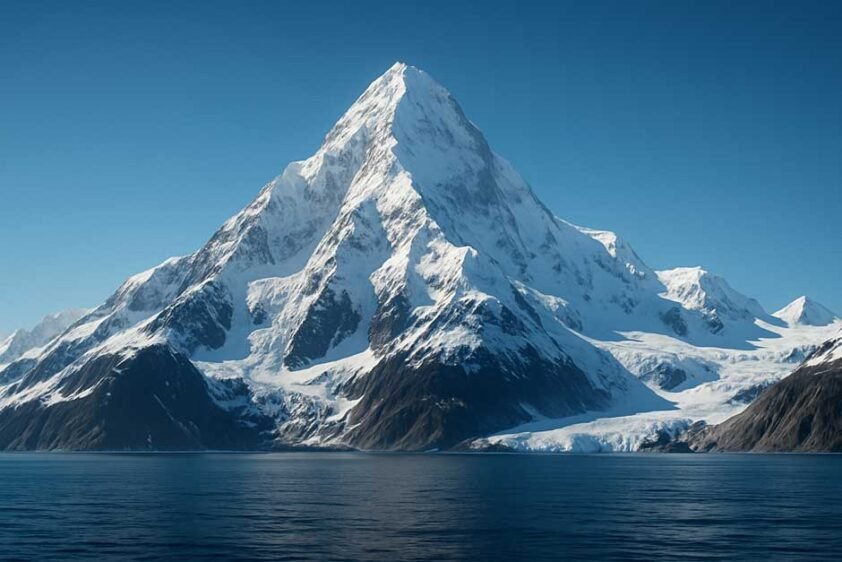
The mountain is a spectacular convergence of ice, rock, and ocean, a place where the forces of nature are displayed in their most raw and powerful form.
The Mountain’s Unique Identity
Mt St Elias is a peak of superlatives, known for its extreme weather and complex climbing history.
It is often shrouded in cloud and battered by storms, making any attempt on its slopes a serious undertaking. The mountain’s identity is intrinsically linked to its isolation and its unforgiving environment.
A Colossus of the North: Key Geographic Facts
Standing at 18,008 feet (5,489 meters), Mount Saint Elias is a towering presence in the Saint Elias Mountains range.
It is the second-highest peak in both the United States and Canada, a distinction that highlights its immense size and its position straddling a major international boundary.
The mountain is a massive, ice-covered dome, feeding some of the largest glaciers in the world, including the vast Malaspina Glacier.
Bordering Two Nations
The summit of Mt St Elias sits precisely on the border between the U.S. state of Alaska and Canada’s Yukon Territory.
This dual nationality adds a layer of complexity and fascination to its geography. The mountain is a shared natural monument, respected and revered by both nations.
On the American side, it is part of the Wrangell-St. Elias National Park and Preserve, a UNESCO World Heritage Site.
The Race to the Summit: Early Climbing History
For decades after its sighting in 1741 by Danish explorer Vitus Bering, the peak remained unconquered.
The mountain’s remote location, combined with its severe weather and technical difficulties, made it a prize that eluded many early mountaineers.
The Lure of the Unclimbed
The challenge of Mt St Elias was not just the altitude, but the sheer distance and logistical nightmare of reaching its base.
Expeditions had to contend with vast icefields, deep crevasses, and the constant threat of avalanches, all before even beginning the true ascent.
It was a symbol of the last great unclimbed peaks in North America, drawing ambitious climbers from around the globe.
The Duke’s Triumph: The First Successful Ascent
The honor of the first successful ascent belongs to an Italian expedition led by Prince Luigi Amedeo, Duke of the Abruzzi.
On July 31, 1897, the Duke and his team reached the summit, marking a significant milestone in mountaineering history.
Prince Luigi Amedeo’s Expedition
The Duke’s expedition was a masterpiece of planning and execution, demonstrating the necessary commitment to tackle such a formidable peak.
They chose a route that was both challenging and strategically sound, overcoming the mountain’s defenses with skill and determination.
Their success established a legacy of exploration and set the standard for future attempts on the mountain.
Climbing the “Jinx Mountain”: Modern Challenges and Routes
Despite its early conquest, Mt St Elias earned the nickname “Jinx Mountain” due to the high number of failed and tragic expeditions that followed.
The mountain’s reputation for unpredictable weather and dangerous conditions continues to this day, demanding the utmost respect from climbers.
Modern ascents are rare and typically follow the easier, though still demanding, Abruzzi route.
The Sea-to-Summit Challenge
A unique and extreme challenge associated with Mt St Elias is the “sea-to-summit” climb.
This involves starting at sea level and climbing the entire vertical distance to the summit, a feat that represents one of the greatest continuous vertical gains on Earth.
It is a testament to the mountain’s incredible vertical relief and the enduring spirit of adventure.
Wrangell-St. Elias National Park: A Wilderness Sanctuary
The mountain is the centerpiece of the largest national park in the United States, the Wrangell-St. Elias National Park and Preserve.
This vast protected area encompasses an incredible diversity of landscapes, from coastal fjords to high-alpine peaks and immense glaciers.
Protecting a Pristine Ecosystem
The park serves as a vital sanctuary for wildlife, including grizzly bears, Dall sheep, and mountain goats.
It is a place where the natural environment remains largely untouched by human development, offering a glimpse into a truly wild North America.
The preservation of this ecosystem is as important as the mountain itself, ensuring its majesty endures for future generations.
Frequently Asked Questions (FAQ) about Mt St Elias
How tall is Mt St Elias?
Mt St Elias stands at an elevation of 18,008 feet (5,489 meters). This makes it the second-highest peak in both the United States and Canada.
Where is Mt St Elias located?
The mountain is located on the international border between the U.S. state of Alaska and the Canadian territory of Yukon, within the Saint Elias Mountains range.
Why is Mt St Elias called the “Jinx Mountain”?
It earned the nickname “Jinx Mountain” due to the high number of failed and sometimes fatal climbing expeditions that occurred after the first successful ascent in 1897. The mountain’s severe weather and remote location make it exceptionally dangerous.