
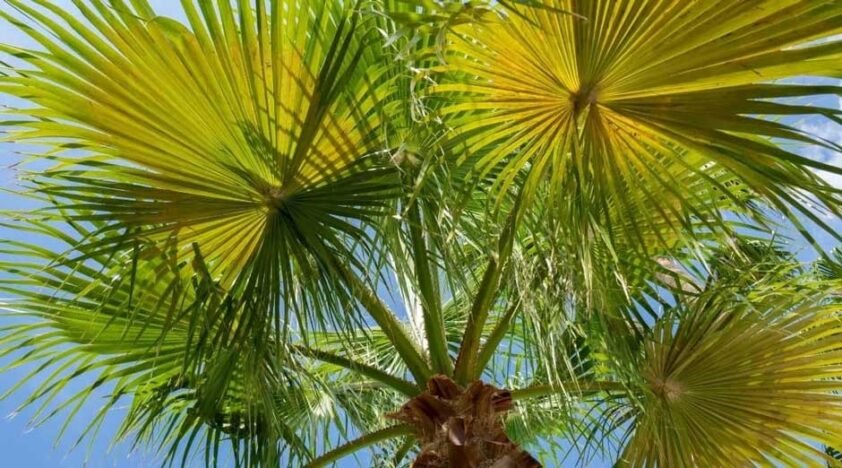
The Mexican Fan Palm, or *Washingtonia robusta*, is a truly striking and iconic tree that instantly brings to mind sun-drenched boulevards and warm, tropical landscapes. Originally from the Baja California peninsula and parts of Sonora in Mexico, this palm has become a global favorite, cherished for its impressive height and remarkably fast growth [1]. With its slender, columnar trunk and a crown of large, fanning fronds, it serves as a dramatic, natural focal point in any setting, from bustling urban parks to quiet coastal gardens.
The Defining Characteristics of *Washingtonia robusta*
Perhaps the most distinguishing feature of the Mexican Fan Palm is its sheer verticality. This is a genuinely fast-growing species, often adding up to three feet of height annually, and it can ultimately reach a staggering 70 to 100 feet [2]. When compared to its close relative, the California Fan Palm (*Washingtonia filifera*), *W. robusta* stands out with a much more slender trunk. This trunk can taper dramatically, starting at nearly two feet in diameter at the base and narrowing to as little as eight inches near the top of very old specimens.
The Iconic “Petticoat” and Fronds
The leaves themselves are large, fan-shaped (palmate), and quite impressive, often measuring between three to five feet wide. A word of caution: the petioles, or leaf stems, are armed with sharp teeth, so care should be taken when working around the tree. As the older fronds naturally die off, they fold down against the trunk, creating a dense, brown layer that is famously known as a “petticoat” or “hula skirt” [2]. While this skirt is a natural and often attractive feature, it is frequently removed in urban environments, primarily because it can pose a fire hazard, but also for a cleaner aesthetic.
Essential Care and Cultivation
Despite its imposing size, the Mexican Fan Palm is surprisingly low-maintenance once it has established itself, which is a major reason it remains a popular choice for landscapers. Nevertheless, a basic understanding of its needs is crucial for ensuring you have a healthy, long-lived specimen that reaches its full potential.
Light and Temperature Requirements
This palm absolutely thrives in full sun, ideally needing at least six to eight hours of direct sunlight every day for the best growth [1]. Although it originates from desert regions and is highly heat-tolerant, it also possesses a remarkable degree of cold hardiness. Mature palms are known to withstand temperatures dropping as low as 20 degrees Fahrenheit, which means they are a viable option for those in USDA hardiness zone 9A and warmer [3].
Soil and Watering Needs
*Washingtonia robusta* does best in loamy, sandy, and most importantly, well-draining soil. Interestingly, while many people think of it as a pure desert palm, it naturally grows in areas where there is permanent surface or subsurface water. This means it is not quite as drought-tolerant as one might initially assume [3]. The best practice is to allow the soil to dry out completely between deep, thorough waterings. Be warned, though: constantly wet or waterlogged soils will quickly cause the palm to decline.
Fertilization and Nutrient Deficiency
Due to its rapid growth, the Mexican Fan Palm is quite susceptible to potassium (K) deficiency. This is a common issue that manifests as leaflet tip necrosis and the premature death of older leaves [3]. To prevent this, a high-quality, slow-release fertilizer, specifically made for palms and containing a balanced ratio of key nutrients, is essential throughout the growing season. A critical piece of advice is never to remove the discolored or partially necrotic older leaves, as the palm will actually draw supplementary potassium from them to sustain new growth.
Propagation and Landscape Use
The Mexican Fan Palm is a solitary palm and does not produce suckers, meaning propagation must be done exclusively from seed. The good news is that the seeds germinate quite readily under warm, moist conditions, often sprouting within just two weeks [3]. This very ease of propagation has contributed to its widespread use, but it has also led to its classification as an invasive species in some regions, particularly parts of Florida and California.
In a landscape setting, its incredible height makes it an excellent choice for large properties, commercial developments, and as a dramatic, stately street tree. It is remarkably tolerant of tough urban conditions, including salt spray and wind, which makes it a resilient option for both coastal and city environments. That said, its sheer ultimate size means it is often simply too tall for typical small residential gardens, where it can easily overwhelm the space and may even pose a risk during severe weather [3].
Common Challenges and Management
While the Mexican Fan Palm is generally a hardy specimen, it is not entirely immune to problems. Beyond the common potassium deficiency, it can be affected by several serious fungal diseases. **Ganoderma butt rot**, for instance, is a lethal and untreatable basal trunk rot that can eventually cause the entire palm to collapse. Another serious threat is **Thielaviopsis trunk rot**, which typically gains entry through wounds—often those caused by improper pruning or rough handling—and rapidly rots the upper trunk [3]. The best defense against these serious issues is proper cultural care, which includes strictly avoiding trunk wounding and ensuring the palm receives adequate nutrition.