

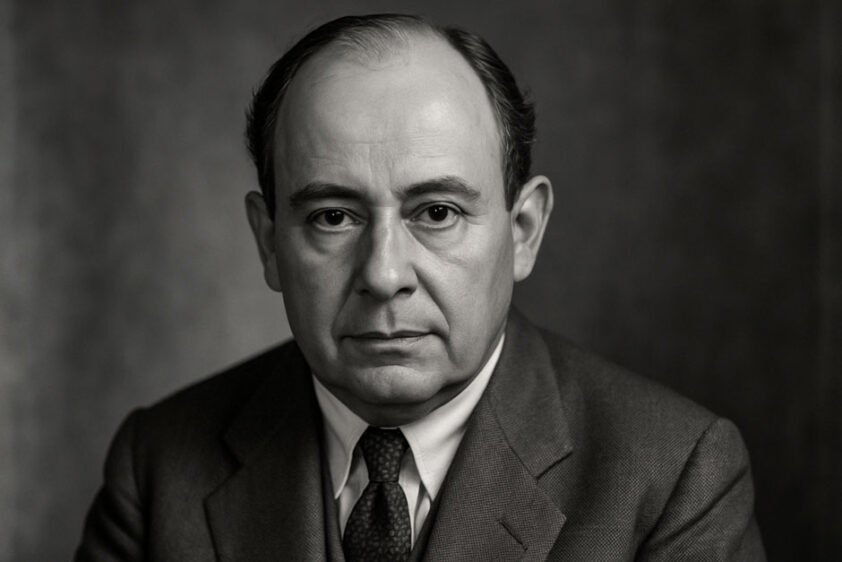
John von Neumann, born Neumann János Lajos in Budapest in 1903, was a figure of towering intellect whose work spanned and fundamentally reshaped numerous fields of science. He was a Hungarian and American mathematician, physicist, computer scientist, and engineer, often described as having the widest coverage of any mathematician of his time.
His contributions were not confined to a single discipline; rather, they created bridges between pure mathematics, applied science, and the emerging technologies of the 20th century. Von Neumann’s legacy is deeply embedded in the foundations of modern computing, economics, and even the understanding of complex systems.
Von Neumann was a true child prodigy, displaying an astonishing memory and a mastery of complex concepts from a very young age. By the age of eight, he was reportedly familiar with differential and integral calculus, and he had read a 46-volume world history series.
Despite his prodigious talent for mathematics, his father encouraged him to pursue a more practical career, leading him to study chemical engineering. However, he simultaneously pursued his passion for mathematics, publishing two major papers by the age of 19.
He earned a diploma in chemical engineering from ETH Zurich and a Ph.D. in mathematics from the University of Budapest, both by the age of 23. This dual education set the stage for his later ability to bridge theoretical and applied sciences.
A Foundation for Modern Computing: The Von Neumann Architecture
Perhaps von Neumann’s most pervasive contribution is the conceptual framework for nearly all modern digital computers. This is universally known as the von Neumann architecture.
His 1945 paper, “First Draft of a Report on the EDVAC,” outlined the design where a computer’s program and data are stored in the same memory space. This concept of the stored-program computer revolutionized early computing efforts.
The architecture, characterized by a central processing unit (CPU), memory, and input/output mechanisms, remains the fundamental blueprint for systems ranging from personal computers to supercomputers. It is the silent, essential engine of the digital world we inhabit today.
The Mathematics of Conflict: Pioneering Game Theory
Von Neumann is widely recognized as the father of game theory, a mathematical framework for analyzing strategic interactions between rational decision-makers. His work transformed economics and social sciences.
In 1928, he published his seminal paper, “Zur Theorie der Gesellschaftsspiele” (On the Theory of Games), which established the minimax theorem for two-person zero-sum games. This theorem is a cornerstone of the field.
Later, his collaboration with economist Oskar Morgenstern resulted in the groundbreaking 1944 book, Theory of Games and Economic Behavior. This work extended the theory to a broader range of economic and strategic situations, making it a powerful tool for analysis.
Unifying the Sciences: Contributions to Quantum Mechanics and Functional Analysis
Before his work in computing and economics, von Neumann made profound contributions to the mathematical foundations of quantum mechanics. He provided a rigorous mathematical formulation of the theory.
His 1932 book, Mathematical Foundations of Quantum Mechanics, remains a classic text, introducing concepts like the density matrix and establishing the theory on the basis of Hilbert spaces. This work brought clarity and rigor to a revolutionary but initially confusing field of physics.
Furthermore, his work in functional analysis led to the development of von Neumann algebras, a class of operator algebras that are now fundamental tools in advanced mathematics and theoretical physics. His intellectual reach was truly immense.
The Manhattan Project and Cold War Influence
During World War II, von Neumann’s practical genius was put to use in the Manhattan Project. He played a crucial role in the development of the implosion-type nuclear weapon.
He devised the mathematical models for the explosive lenses needed to compress the plutonium core symmetrically, a task of immense complexity. His calculations were vital to the success of the Trinity test and the subsequent weapon used at Nagasaki.
After the war, he served on the U.S. Atomic Energy Commission, becoming a leading voice in defense policy and nuclear strategy. His influence extended to the development of intercontinental ballistic missiles (ICBMs), where he advocated for a rapid, aggressive approach.
The Visionary’s Legacy: Cellular Automata and Self-Replication
Beyond his immediate, world-changing contributions, von Neumann also explored the theoretical limits of computation and life itself. He pioneered the concept of cellular automata.
He conceived of a self-reproducing machine, a theoretical model that could replicate itself within a given environment. This work on self-replication, or “universal constructors,” predated the discovery of the structure of DNA and offered a deep insight into the logic of biological reproduction.
His theoretical work in this area laid the groundwork for modern studies in complex systems, artificial life, and the very nature of information processing. It is a testament to his forward-thinking mind.
A Mind Like No Other: Personality and Impact
Von Neumann was known for his quick wit, exceptional memory, and a playful, often jovial personality. He was a captivating conversationalist who could effortlessly switch between complex scientific topics and lighthearted anecdotes.
His ability to rapidly absorb and synthesize information across disparate fields was legendary among his colleagues, including Albert Einstein and J. Robert Oppenheimer. He was a synthesizer, a promoter, and a brilliant problem-solver.
Though his life was cut short by cancer in 1957 at the age of 53, the impact of John von Neumann’s work continues to shape the world. From the computer on your desk to the principles of global strategy, his legacy endures as one of the most influential minds of the 20th century.