

The Unlikely Rise of a Jazz Legend
In the annals of music history, few stories are as compelling as that of Django Reinhardt, the Belgian-born Romani musician who not only became Europe’s first major jazz star but also fundamentally changed the role of the guitar in the genre. His journey was one of immense talent, profound adversity, and relentless innovation.
From Gypsy Caravan to Parisian Cafes
Born Jean Reinhardt in a gypsy caravan in 1910, Django’s early life was spent in the Romani encampments on the outskirts of Paris. Immersed in a musical family, he was a natural, teaching himself to play the violin, banjo, and guitar by mimicking the musicians around him.
By the age of 15, the young prodigy was already earning a living by performing in the city’s cafes and dance halls. His world was one of vibrant French musette and traditional Romani music, but the winds of change were blowing from across the Atlantic.
A Trial by Fire
In 1928, at the age of 18, tragedy struck. A fire in his caravan left Reinhardt with severe burns, and doctors feared he would never play the guitar again. The fourth and fifth fingers of his left hand were permanently damaged, a devastating blow for any string player.
Yet, during his long and painful recovery, Django’s spirit remained unbroken. He developed a revolutionary technique, using only his two healthy fingers—the index and middle—for his intricate solo work. This incredible adaptation would become the hallmark of his unique and virtuosic style.
The Birth of Gypsy Jazz
While recuperating, Reinhardt was introduced to the sounds of American jazz, particularly the music of Louis Armstrong and Duke Ellington. This new, swinging art form captivated him and set him on a new musical path, one that would lead to the creation of an entirely new genre.
A New Sound with the Quintette du Hot Club de France
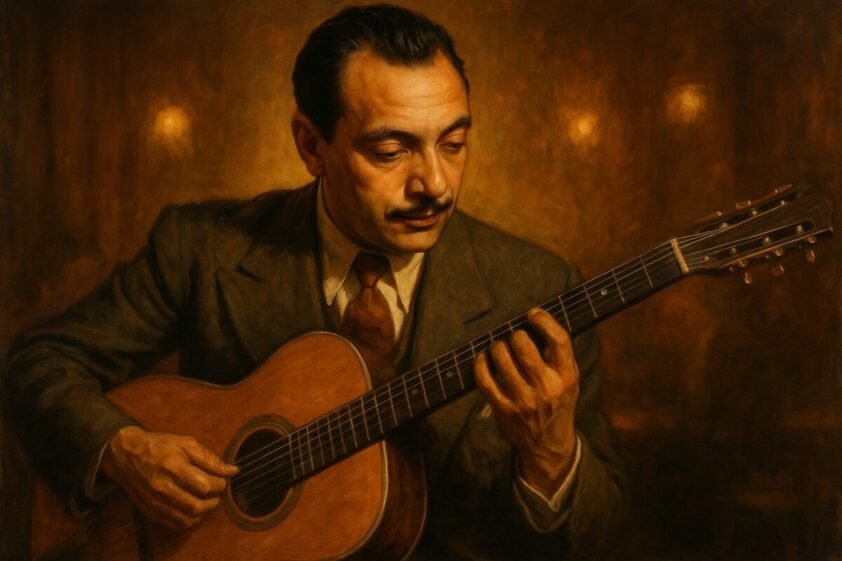
In 1934, Django Reinhardt joined forces with the gifted violinist Stéphane Grappelli to form the Quintette du Hot Club de France. The group’s all-string lineup—featuring three guitars, a violin, and a double bass—was a radical departure from the horn-led jazz bands of the era.
This unique instrumentation, free from the powerful sound of drums and brass, allowed Reinhardt’s acoustic guitar to step into the spotlight. For the first time, the guitar was not just a rhythm instrument but a lead voice, capable of dazzling improvisation and profound melodic expression.
The Two-Fingered Genius
With his unorthodox two-fingered technique, Django produced a sound that was both technically astonishing and deeply soulful. He combined the harmonic sophistication of American jazz with the fiery, passionate spirit of his Romani heritage, creating the style that would come to be known as “gypsy jazz.”
Compositions like “Minor Swing” and “Nuages” became instant classics, showcasing the telepathic interplay between Reinhardt’s guitar and Grappelli’s violin. The Quintette achieved massive success in Europe, forever cementing Django’s place as a musical innovator.
A Lasting Legacy
Django Reinhardt’s influence extends far beyond the world of gypsy jazz. His technical prowess and creative vision inspired countless musicians across genres and generations, from jazz legends to rock icons.
The American Dream and Beyond
In 1946, Reinhardt’s dream of playing with the American jazz masters came true when he was invited to tour with Duke Ellington’s orchestra. Though the tour had its challenges, it was a testament to his status as a world-class musician.
He continued to evolve, absorbing the new sounds of bebop and experimenting with the electric guitar. Tragically, his life was cut short by a stroke in 1953 at the age of 43, but his musical legacy was already secure.
The Enduring Influence of a Musical Pioneer
Today, Django Reinhardt’s music is celebrated worldwide. Annual festivals bear his name, and his compositions remain essential standards for jazz guitarists. He is remembered not just for his incredible talent, but for his resilience in the face of life-altering adversity.
The story of the Django Reinhardt musician is a powerful reminder that true artistry knows no barriers. He overcame physical limitations and cultural prejudices to create a sound that was entirely his own, leaving an indelible mark on the history of music.