

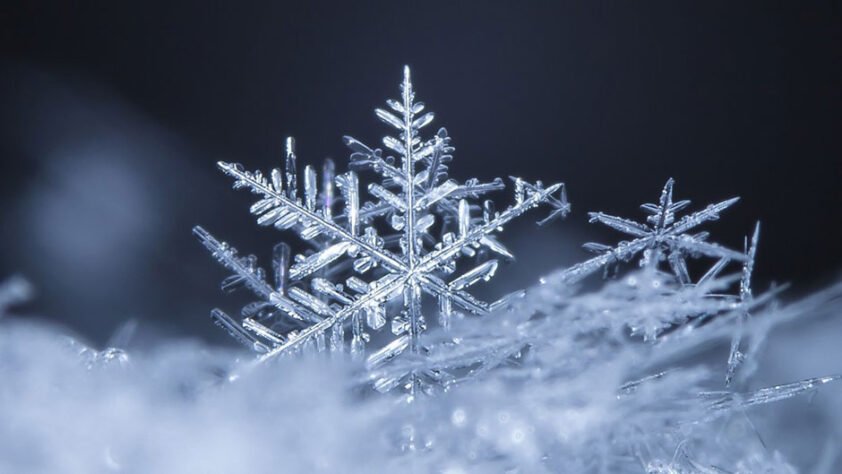
Have you ever paused to truly look at a snow flake as it drifts down from the sky? The question of whether every single one is unique has captivated scientists and dreamers for centuries. It is a query that touches on the vast complexity of nature, where simple water molecules combine to form structures of astonishing beauty and infinite variation.
This article explores the fascinating journey of these tiny ice crystals, from their invisible birth high in the atmosphere to their final, fleeting moment on the ground.
The Humble Beginning: How a Snow Flake is Born
A snow flake does not begin as a perfect crystal. Its life starts with a microscopic speck of dust, pollen, or soot floating in a cloud.
This tiny particle, known as a condensation nucleus, is essential. It provides a surface for supercooled water vapor—water that is still liquid below the freezing point—to freeze onto.
Once this initial ice crystal forms, it is almost always a simple, six-sided prism. This basic hexagonal shape is the fundamental blueprint for all subsequent growth.
Nature’s Perfect Geometry: Understanding the Six-Sided Shape
The six-sided symmetry of every snow flake is not random; it is a direct result of the molecular structure of water. Water molecules naturally arrange themselves into a hexagonal lattice when they freeze.
As the crystal grows, water vapor molecules attach themselves to the corners and edges of this initial hexagon. Because the corners are the most exposed and energetically favorable spots, the crystal tends to grow outward in six directions.
This process gives rise to the three main types of snow crystals: plates (flat and thin), columns (long and narrow), and the most famous, dendrites (branching, fern-like stars).
The Journey Through the Sky: Temperature and Humidity’s Role
The final, intricate shape of a snow flake is a detailed record of its entire journey through the atmosphere. It is a story written in ice, dictated by the precise temperature and humidity conditions it encounters.
As the crystal falls, it passes through layers of air with varying conditions. A slight change in temperature, even by a single degree, can dramatically alter the way water vapor freezes onto the crystal’s surface.
For example, temperatures around -15°C often produce the elaborate, feathery dendrites that people most associate with a classic snow flake. Warmer temperatures tend to create simpler, plate-like crystals.
The humidity, or the amount of water vapor available, determines how quickly the crystal grows. High humidity leads to rapid growth and the formation of complex branches and arms.
The Myth and the Truth: Is Every Snow Flake Unique?
The popular belief that no two snow flakes are exactly alike was largely popularized by Wilson Bentley, a farmer from Vermont who took the first detailed photographs of snow crystals in the late 19th century.
Statistically, the sheer number of possible paths a crystal can take, combined with the infinite variations in temperature and humidity, makes the probability of two identical snow flakes forming and reaching the ground almost zero.
However, scientists have occasionally found simple, small ice crystals that appear to be identical under a microscope. For the large, complex, and beautiful dendritic snow flakes, the claim of uniqueness holds true.
Each complex snow flake is a unique, ephemeral masterpiece, a testament to the chaotic yet beautiful processes of the winter sky.
Beyond the Beauty: The Ecological Importance of Snow
While the aesthetic beauty of snow flakes is undeniable, their role in the environment is far more critical than just decoration. Snow is a vital component of the global climate system.
The blanket of snow acts as an excellent insulator for the ground beneath it, protecting plants and small animals from extreme cold. This layer prevents the ground from freezing too deeply, allowing life to survive the winter.
Furthermore, snowpack is a crucial natural reservoir. The slow melt of accumulated snow in the spring provides a steady, reliable source of fresh water for rivers, agriculture, and human consumption throughout the warmer months.
Frequently Asked Questions (FAQs) About Snow Flakes
H3: What is the largest snow flake ever recorded?
The largest snow flake on record was reportedly found in Fort Keogh, Montana, in 1887. It was described as being 15 inches wide and 8 inches thick, though this measurement is widely disputed and likely refers to an aggregation of many flakes.
H3: Why does snow appear white?
Snow is made of clear ice crystals. It appears white because the light from the sun is scattered equally by the many facets of the ice crystals. This scattering of all colors of the visible spectrum results in the perception of white light.
H3: How many sides does a snow flake have?
Every true snow flake, which is a single ice crystal, has six sides. This is due to the hexagonal structure of the water molecule when it freezes. You will never find a natural snow crystal with five or seven sides.
H3: Do snow flakes make a sound when they fall?
While the individual snow flake is too light to make an audible sound, a heavy snowfall can create a noticeable muffling effect. The soft, porous structure of the snow absorbs sound waves, making the environment seem quieter.