

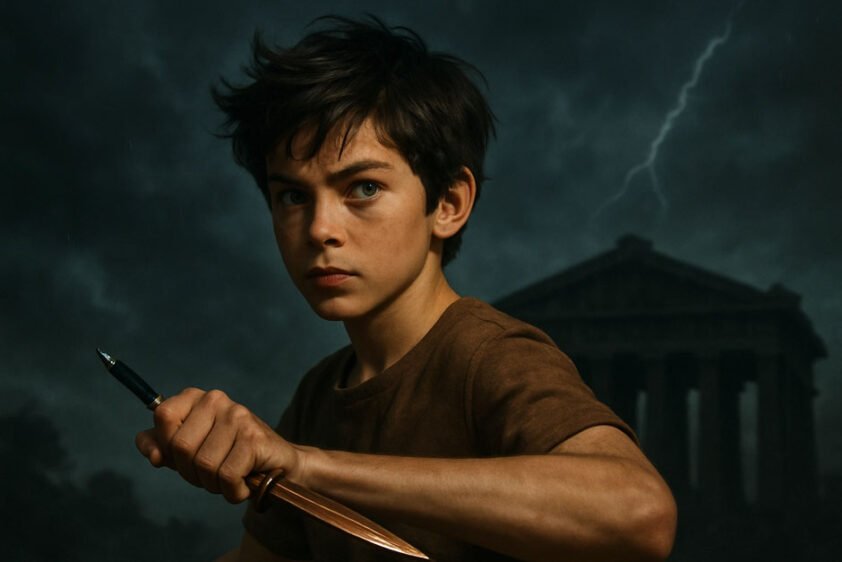
The Boy Who Didn’t Know He Was a God: Why Rick Riordan’s Percy Jackson and the Lightning Thief Still Resonates
What if the myths you read about in school were not just dusty old stories, but a hidden reality operating just beneath the surface of the modern world? This is the electrifying premise at the heart of Rick Riordan’s Percy Jackson and the Lightning Thief, a book that redefined young adult fantasy.
It asks readers to suspend their disbelief and imagine a world where Mount Olympus sits atop the Empire State Building and the gods of ancient Greece still meddle in the affairs of mortals. This blend of the familiar and the fantastical is a key reason for the book’s enduring appeal.
The story’s success lies not only in its imaginative world-building but also in its ability to ground the epic in the struggles of a very ordinary, yet deeply sympathetic, twelve-year-old boy.
The Quest Begins: A Modern Take on Ancient Myths
The narrative structure of The Lightning Thief is a masterful modern retelling of the classic hero’s journey. Percy Jackson, a troubled kid with dyslexia and ADHD, suddenly finds his world turned upside down.
He discovers he is a demigod, the son of Poseidon, and is immediately thrust into a dangerous quest to prevent a war between the Olympian gods. This sudden shift from normalcy to destiny is instantly captivating.
The book takes readers on a thrilling cross-country adventure, replacing ancient temples with modern landmarks like the Gateway Arch and the Underworld entrance in Los Angeles. This clever juxtaposition makes the ancient myths feel fresh and immediate.
The Relatable Hero: Percy Jackson’s Journey
Percy is far from the flawless, stoic heroes of old. He is sarcastic, impulsive, and often feels like an outsider, traits that make him incredibly relatable to young readers.
His struggles with learning disabilities are reframed as signs of his demigod heritage, offering a powerful message of validation and self-acceptance to children who face similar challenges.
He is a hero defined by his loyalty and his willingness to protect his friends, Annabeth and Grover, even when the odds are stacked against him. His humanity is his greatest strength.
Unpacking the Core Themes
Beyond the action and mythology, The Lightning Thief explores profound themes that resonate with readers of all ages. The book is a rich tapestry woven with lessons about identity, family, and belonging.
Finding Identity in a World of Gods
The central conflict for Percy is the search for his own identity. He must reconcile his life as a mortal boy with his newly discovered divine parentage.
This struggle mirrors the universal adolescent quest to figure out who they are and where they fit in the world. The camp for demigods, Camp Half-Blood, becomes a crucial space for this self-discovery.
It is a place where his perceived weaknesses are celebrated as strengths, allowing him to finally understand and embrace his true self.
The Power of Found Family
The bonds Percy forms with Annabeth Chase, the daughter of Athena, and Grover Underwood, the satyr, are the emotional anchors of the story. They are a trio of outcasts who find strength and acceptance in each other.
This theme of “found family” is a powerful counterpoint to the often-absent or complicated relationships the demigods have with their divine parents. Their loyalty to one another is the true magic that drives the quest forward.
Riordan’s Signature Style: Humor and Pacing
Rick Riordan’s writing is characterized by its fast-paced action and sharp, witty humor. Percy’s internal monologue is filled with sarcasm and funny observations, making even the most tense moments enjoyable.
The book moves at a relentless pace, with a monster attack or a new mythological encounter seemingly around every corner. This ensures that the reader is constantly engaged and eager to turn the next page.
This energetic style is what transforms a story about ancient gods into a modern page-turner that appeals to reluctant readers and seasoned fantasy fans alike.
Legacy and Impact: Modernizing Greek Mythology
The impact of The Lightning Thief on modern literature and education cannot be overstated. It has inspired a generation of readers to delve into Greek mythology, often making the subject cool and accessible for the first time.
Riordan’s work successfully demystifies the complex pantheon of gods and heroes by placing them in contemporary settings and giving them modern personalities. He has created a gateway to classical studies.
The book’s success launched a massive literary franchise, but its true legacy is in proving that ancient stories can still hold immense power when told through a modern, diverse, and relatable lens.
Conclusion: The Hero’s Journey Continues
From its thrilling opening to its satisfying conclusion, Rick Riordan’s Percy Jackson and the Lightning Thief is more than just a fantasy novel; it is a cultural phenomenon. It is a story about finding your place, embracing your flaws, and realizing that the greatest power lies not in divine heritage, but in friendship and courage.
The journey of Percy Jackson continues to inspire, reminding us that even the most unlikely heroes can save the world.
Frequently Asked Questions (FAQ)
Is “The Lightning Thief” suitable for all ages?
The book is generally recommended for middle-grade readers, typically ages 8 to 12, but its themes and engaging plot make it enjoyable for teenagers and adults as well. It is a perfect family read.
What are the main themes of the book?
Key themes include the search for identity, the importance of family (both biological and found), loyalty and friendship, and the idea that perceived weaknesses, like ADHD and dyslexia, can be hidden strengths.
How does Rick Riordan make Greek mythology accessible?
Riordan achieves this by setting the mythological world in modern-day America, giving the gods and monsters contemporary personalities, and using a relatable, humorous narrator to guide the reader through the complex lore.