

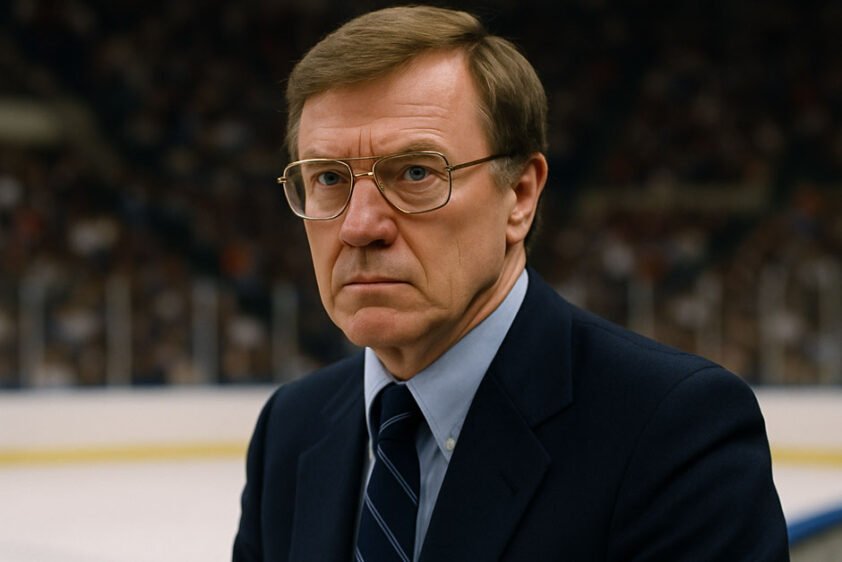
Introduction: The Unconventional Visionary
How does a coach take a team of college amateurs and lead them to one of the greatest upsets in sports history? This is the enduring question that surrounds the legacy of Herb Brooks.
His name is synonymous with the “Miracle on Ice,” the stunning victory of the young American hockey team over the seemingly invincible Soviet Union squad at the 1980 Winter Olympics in Lake Placid.
Brooks was more than just a coach; he was an architect of belief, a master psychologist who understood that to achieve the impossible, one must first be willing to be uncomfortable.
His unique philosophy and demanding methods were the crucible in which a group of rivals was forged into a cohesive, world-beating unit.
The Formative Years: A Player’s Perspective
From St. Paul to the Olympic Rink
Herbert Paul Brooks was born in St. Paul, Minnesota, a heartland for American hockey. He grew up immersed in the sport, developing a keen understanding of the game’s nuances from a young age.
His playing career was respectable, culminating in a spot on the 1960 U.S. Olympic hockey team roster.
Brooks was a talented player, but his true destiny lay not on the ice as an athlete, but behind the bench as a strategist.
The Cut That Fueled a Fire
Just one week before the 1960 Winter Olympics began, Brooks was the last player cut from the team. The U.S. team went on to win the gold medal without him.
This moment of profound disappointment was not a setback, but a catalyst. It instilled in him a fierce, unyielding determination and a deep understanding of what it takes to build a champion.
It is widely believed that this personal slight fueled his entire coaching career, driving him to prove his worth and push his players beyond their perceived limits.
Forging the ‘Miracle on Ice’ Team
The Unorthodox Selection Process
When assembling the 1980 Olympic team, Brooks ignored traditional rivalries and conventional wisdom. He famously selected players from the University of Minnesota and Boston University, two programs with a bitter history.
His goal was not to pick the best individual players, but the right players—those who possessed the character, intelligence, and willingness to adapt to his European-style system.
He deliberately created an environment of constant pressure and discomfort, believing that adversity would strip away their college allegiances and force them to rely on each other.
“You Don’t Beat the Soviets, You Beat the World”
Brooks’s psychological approach was as revolutionary as his coaching tactics. He was known for his aloofness and his relentless, often harsh, demands.
He pushed his players to the brink of exhaustion, using a system of constant testing to break down their egos and rebuild them as a unified team.
His mantra was clear: the Soviet team was not just an opponent; they were a symbol of a dominant, professional system that the American amateurs had to overcome.
The Defining Moment: Lake Placid 1980
The Game That Transcended Sport
The match against the Soviet Union on February 22, 1980, was more than a hockey game; it was a Cold War proxy battle played out on the ice. The Soviets were four-time defending gold medalists and widely considered the best team in the world.
The young American team, against all odds, defeated the Soviet machine 4-3 in a stunning display of grit and execution.
The victory sent shockwaves across the globe, providing a much-needed moment of national pride and unity for the United States.
The Iconic Post-Game Question
Following the victory, Brooks delivered one of the most famous and simple post-game speeches in sports history. He walked into the locker room and, after a moment of silence, asked his players a single, powerful question.
“Who do you play for?” he demanded. The players, finally understanding the depth of his vision, responded in unison: “The United States of America!”
This moment perfectly encapsulated the journey he had forced them to take, transforming them from college rivals into national heroes.
A Lasting Coaching Legacy
After the “Miracle on Ice,” Brooks continued his career at the highest levels of the sport. He coached several NHL teams, including the New York Rangers, the Minnesota North Stars, and the Pittsburgh Penguins.
His influence extended to the international stage once more when he led the French Olympic team in 1998 and, notably, the 2002 U.S. Olympic team to a silver medal in Salt Lake City.
His coaching philosophy—a blend of European-style speed and finesse with North American toughness—has had a profound and lasting impact on modern hockey strategy.
The Final Whistle: Remembering Herb Brooks
Herb Brooks’s life was tragically cut short on August 11, 2003, when he died in a single-car accident at the age of 66.
His death was a loss to the hockey world, but his legacy endures. He was posthumously inducted into the Hockey Hall of Fame in 2004.
The “Miracle on Ice” remains his defining achievement, a testament to his belief that a team, properly motivated and prepared, can achieve anything.
Frequently Asked Questions (FAQ)
Q: What was Herb Brooks’ most famous quote?
A: While he had many memorable lines, his most famous quote is often cited as the line he delivered to his team before the final game: “You were born to be a player. You were meant to be here. This is your moment.”
Q: Did Herb Brooks coach any other teams after the 1980 Olympics?
A: Yes, he coached several NHL teams, including the New York Rangers, Minnesota North Stars, New Jersey Devils, and Pittsburgh Penguins. He also coached the French Olympic team in 1998 and the US Olympic team again in 2002, winning a silver medal.
Q: How did Herb Brooks die?
A: Herb Brooks died in a single-car accident on August 11, 2003, at the age of 66.