

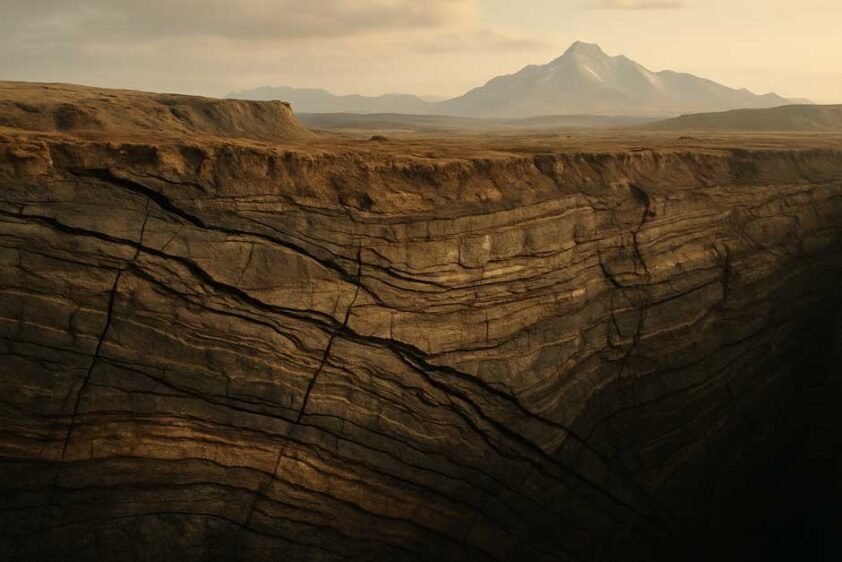
John McPhee’s Pulitzer Prize-winning work, Annals of the Former World, isn’t just a book about rocks and dirt. It’s a profound meditation on deep time and the vast, slow-motion processes that have shaped the North American continent.
It is a monumental achievement in science writing, weaving together complex geological concepts with vivid portraits of the geologists who dedicate their lives to deciphering the Earth’s history.
This literary journey takes the reader across the fortieth parallel of the United States, from the Atlantic to the Pacific, tracing the geological narrative of the continent’s formation.
The book is a synthesis of five separate works, originally published between 1981 and 1993, culminating in a single, cohesive volume that captures the essence of American geology.
A Tapestry of Five Books: The Structure of the Annals
The book’s structure is quite unique, built upon four previously published works and a new concluding essay. This compilation allows McPhee to explore different facets of North American geology, each with its own focus and cast of characters.
Basin and Range: The Westward Expansion
The first section delves into the Basin and Range Province, a vast area characterized by alternating mountain ranges and valleys.
Here, McPhee introduces the concept of plate tectonics and the immense forces that stretch and pull the Earth’s crust. The narrative is driven by the colorful personalities of the geologists, making the dry science come alive.
In Suspect Terrain: The Appalachian Story
Moving eastward, In Suspect Terrain focuses on the complex, folded, and faulted geology of the Appalachian Mountains.
This part explores the theory of continental drift and how ancient landmasses collided to form this venerable mountain chain. It highlights the often-contentious nature of scientific discovery.
Rising from the Plains: Wyoming’s Geological Drama
Rising from the Plains is perhaps the most personal of the sections, centered on the life and work of geologist David Love in Wyoming.
It beautifully intertwines the geological history of the Rocky Mountains with the human history of the American West, showing how the land has influenced human settlement and culture.
Assembling California: The Edge of the Continent
The final major section tackles the dynamic and volatile geology of California, a place where the Earth’s plates are actively grinding against each other.
It covers everything from the formation of the Sierra Nevada to the ever-present threat of earthquakes, illustrating the ongoing, dramatic processes at the continent’s edge.
The Art of Science Writing: McPhee’s Unique Voice
McPhee’s genius lies in his ability to translate the abstract and immense scale of geology into accessible, compelling prose. He employs a narrative style that is both rigorously factual and deeply human.
He doesn’t just describe rocks; he tells the stories of the people who study them, capturing their passion, their quirks, and their relentless pursuit of knowledge.
This approach transforms geology from a niche academic subject into a grand, sweeping epic.
The book is a masterclass in literary non-fiction, demonstrating how science can be a source of profound wonder and a lens through which to understand our place in the universe. It is a testament to the power of observation and the enduring mystery of the natural world.
The Enduring Impact and Relevance Today
Despite being published over two decades ago, Annals of the Former World remains a cornerstone of science literature. Its exploration of plate tectonics and deep time is as relevant now as it was then.
For readers, it offers a fundamental shift in perspective, forcing a reconsideration of the fleeting nature of human existence against the backdrop of geological epochs.
It is a powerful reminder that the ground beneath our feet is not static but a constantly moving, evolving entity.
The book has inspired countless students to pursue geology and has given lay readers a deep appreciation for the landscape they inhabit. Its legacy is a richer, more imaginative understanding of the Earth.
Frequently Asked Questions (FAQ) about Annals of the Former World
Who is the author of Annals of the Former World?
The book was written by John McPhee, a renowned American writer and long-time staff writer for The New Yorker. He is widely considered a pioneer of creative non-fiction.
What is the main subject of the book?
The main subject is the geology of the North American continent, specifically along the fortieth parallel, and the geologists who study it. It explores concepts like plate tectonics, deep time, and continental formation.
Did Annals of the Former World win any awards?
Yes, it won the Pulitzer Prize for General Nonfiction in 1999, recognizing its literary merit and its contribution to public understanding of science.
Is the book suitable for non-geologists?
Absolutely. McPhee’s accessible and engaging writing style makes complex geological concepts understandable and fascinating for the general reader. It is often recommended as an excellent entry point into the subject.
What is “deep time” as discussed in the book?
Deep time is a geological concept that refers to the immense span of time over which geological processes occur, often measured in millions and billions of years. The book helps the reader grasp this staggering scale.