
Introduction: The Brightly Colored Visitor
Have you ever noticed a striking, orange-and-black insect clinging to the seed pods of your milkweed plants? This eye-catching creature is the milkweed bug, a common sight across North America wherever its host plant, the milkweed, grows.
While often mistaken for a pest, the milkweed bug is a fascinating example of nature’s defense mechanisms and specialized diets. Understanding its role in the ecosystem is key to coexisting with this vibrant insect in your garden.
This guide will provide a complete overview of the large milkweed bug, from its distinctive appearance and life cycle to its impact on milkweed and the best approaches for control.
What is the Large Milkweed Bug?
The large milkweed bug, scientifically known as Oncopeltus fasciatus, is a true bug belonging to the order Hemiptera. This classification means it possesses piercing-sucking mouthparts, which it uses to feed on plant material.
It is one of the most recognizable insects associated with the milkweed plant, sharing this habitat with the more famous monarch butterfly. Its presence is a clear indicator of a healthy milkweed population.
Appearance and Distinctive Markings
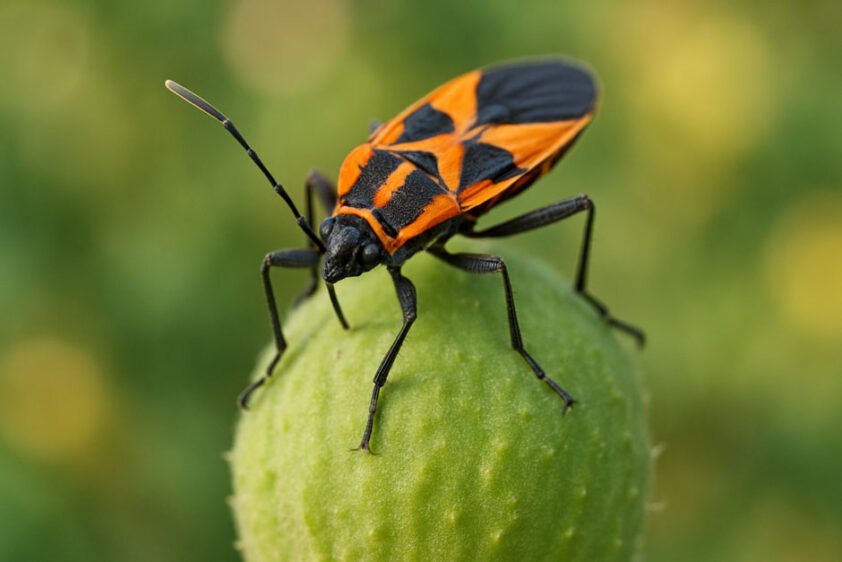
Adult large milkweed bugs are relatively small, typically measuring between 10 to 20 millimeters in length. Their bodies are a brilliant reddish-orange or bright orange, contrasted sharply with bold black markings.
The most prominent feature is a thick black band that runs across the middle of the body, often accompanied by two large, diamond-shaped black patches on the wings. This bright coloration is not for beauty, but for defense.
Classification and Relatives
The large milkweed bug is a member of the family Lygaeidae, commonly known as the seed bugs. There is also a smaller, less common relative, the small milkweed bug (Lygaeus kalmii), which has a slightly different pattern.
The small milkweed bug features a black hourglass shape on its back, rather than the large, solid black patches of its larger cousin. Both species share the same host plant and similar life habits.
The Milkweed Bug Life Cycle
Milkweed bugs undergo incomplete metamorphosis, a process that lacks the pupal stage seen in butterflies and moths. Their life cycle consists of three main stages: egg, nymph, and adult.
The entire process, from egg to adult, can take about a month, allowing for multiple generations to occur during a single warm season, especially in southern regions.
From Egg to Nymph (Instars)
Females lay clusters of bright yellow or orange eggs, often tucked into the crevices of milkweed seed pods or between the pods and the stem. A single female can lay hundreds of eggs in her lifetime.
Once hatched, the young bugs are called nymphs. They are bright red with black antennae and legs, and they lack the full wing structure of the adults.
Nymphs go through five distinct growth stages, or instars, shedding their exoskeleton each time. With each molt, they grow larger and their black markings become more defined.
Adult Stage and Overwintering
After the final molt, the bug emerges as a fully winged adult, ready to reproduce. Adults are the stage responsible for dispersal and migration.
In colder climates, the adult milkweed bugs will overwinter, often congregating in sheltered areas like leaf litter or under bark. They emerge in the spring to find new milkweed plants and begin the cycle anew.
Diet and the Power of Milkweed
The milkweed bug is a specialist feeder, meaning its diet is almost exclusively tied to the milkweed plant (Asclepias species). This specialization is a crucial part of its survival strategy.
They use their sharp mouthparts to pierce the seed pods and feed on the developing seeds, which are rich in nutrients. This feeding habit is the primary reason they are sometimes viewed as a nuisance by gardeners.
Specialist Herbivores and Seed Feeding
While they feed primarily on the seeds, milkweed bugs may also occasionally feed on the leaves and stems of the plant. However, the most significant feeding occurs on the mature seed pods.
The bugs are not known to consume enough plant tissue to seriously harm a healthy, established milkweed plant. Their impact is mainly on the viability of the seeds.
Aposematism: The Warning Coloration
Milkweed plants contain toxic compounds called cardiac glycosides, or cardenolides. When the milkweed bug feeds on the plant, it sequesters these toxins within its body.
This makes the bug unpalatable and potentially poisonous to predators like birds. The bright orange and black coloration is a clear signal—a form of aposematism—warning predators to stay away.
This shared defense mechanism is also famously used by the monarch butterfly, another milkweed specialist.
Are Milkweed Bugs Pests?
The question of whether the milkweed bug is a pest largely depends on the gardener’s goal. For those cultivating milkweed to collect seeds or for commercial purposes, the bugs can be a problem.
However, for the average home gardener who simply wants to support pollinators, the milkweed bug is generally considered a minor nuisance rather than a destructive pest.
Assessing the Damage to Milkweed Plants
Milkweed bugs do not typically kill the host plant. The damage is confined to the seeds, which may be shriveled or fail to develop properly after being fed upon.
If you are growing milkweed specifically to support monarch butterflies, the bugs pose no threat to the caterpillars, which feed on the leaves. In fact, they are part of the natural biodiversity of the milkweed patch.
When and How to Control Them
Control is usually unnecessary unless populations are extremely high or seed collection is a priority. If control is desired, non-chemical methods are highly effective and safer for other beneficial insects.
The simplest method is hand-picking or gently shaking the bugs off the plant into a bucket of soapy water. This is most effective when the bugs are congregated on the seed pods.
For heavy infestations, a strong jet of water from a hose can dislodge the nymphs. Avoid using broad-spectrum insecticides, as these will harm monarch caterpillars and other beneficial insects.
Frequently Asked Questions (FAQ)
Q: Do milkweed bugs bite humans?
No, milkweed bugs do not bite humans. Their mouthparts are designed for piercing plant tissue and sucking out fluids, not for biting skin. They are completely harmless to people and pets.
Q: Are milkweed bugs the same as monarch caterpillars?
No, they are entirely different insects. Monarch caterpillars are the larval stage of the monarch butterfly, which feeds on milkweed leaves. Milkweed bugs are true bugs that primarily feed on milkweed seeds.
Q: What is the difference between the large and small milkweed bug?
The main difference is size and the pattern of black markings. The large milkweed bug (Oncopeltus fasciatus) is bigger and has two large, distinct black spots on its wings. The small milkweed bug (Lygaeus kalmii) is smaller and has a black hourglass-shaped pattern on its back. Both share the same host plant.