
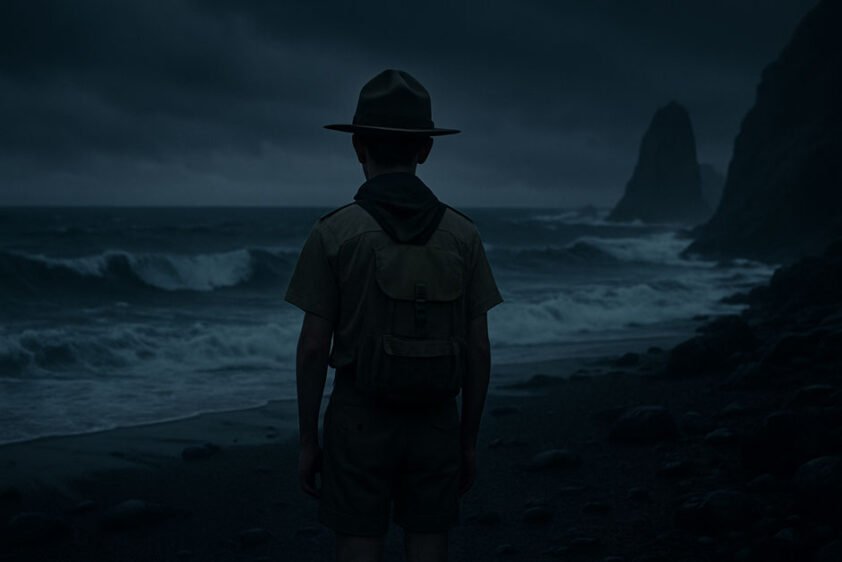
What happens when the idyllic isolation of a Boy Scout camping trip is shattered by a horror more visceral and relentless than any campfire story? This is the chilling question at the heart of The Troop, the acclaimed 2014 horror novel by Nick Cutter.
The book takes the familiar setting of a remote island and transforms it into a claustrophobic stage for a terrifying battle for survival. It is a story that does not pull its punches, delivering a blend of body horror and psychological suspense that has cemented its place as a modern classic.
What is The Troop? A Brief Overview
The Troop is the pseudonym Nick Cutter uses for Canadian author Craig Davidson. The novel was released in 2014 and quickly gained notoriety for its extreme, yet expertly handled, horror elements.
The premise is deceptively simple: a group of five Boy Scouts and their Scoutmaster, Tim Riggs, are on a weekend camping trip on the remote Falstaff Island, off the coast of Prince Edward Island.
Their peaceful retreat is violently interrupted by the arrival of a mysterious, emaciated stranger. This man is not just sick; he is a carrier for a genetically engineered organism that poses an existential threat to the boys.
The Core Conflict: Parasitic Horror Meets Human Nature
The true terror of the novel stems from a highly contagious, rapidly growing tapeworm. This parasite, the result of a rogue scientific experiment, causes extreme hunger and rapid physical deterioration in its host.
The biological horror is intense, forcing the characters to confront the grotesque reality of their situation. However, the external threat is only half the story.
The parasite acts as a catalyst, stripping away the veneer of civilization and exposing the raw, often dark, tendencies of the boys. The isolation of the island ensures that there is no escape from either the infection or each other.
The Boys of Falstaff Island: A Study in Character
Cutter masterfully crafts a small cast of characters, each representing a different facet of teenage vulnerability and cruelty. The novel becomes a study of how different personalities react when pushed to the absolute breaking point.
Tim Riggs: The Scoutmaster’s Tragic Role
Tim Riggs is the well-meaning adult, the figure of authority who is tragically the first to be compromised. His rapid decline sets the stage for the breakdown of order.
His fate is a grim reminder that in the face of true biological horror, good intentions and experience mean very little. The boys are left to fend for themselves, both against the infection and the ensuing chaos.
Shelley: The Sociopath in the Tent
Shelley is arguably the most terrifying element of the novel. He is a deeply disturbed, psychopathic boy whose cruelty is purely human, predating the arrival of the parasite.
His calculated manipulations and cold-blooded actions demonstrate that the greatest monster on the island is not the worm, but the darkness residing within a human heart. He weaponizes the fear and paranoia of his peers.
Max and Newt: The Unlikely Survivors
Max and Newt represent the quiet, intelligent core of the group. They are forced to mature instantly, relying on logic and their bond to navigate the escalating nightmare.
Their struggle is the emotional anchor of the story, a desperate fight to maintain their humanity while everything around them descends into a primal struggle for survival.
Narrative Structure: The Power of Interstitial Documents
One of the novel’s most effective techniques is the use of “extratextual materials” to supplement the main narrative. These include news clippings, interview transcripts, and scientific reports.
These documents serve to expand the scope of the horror, grounding the fantastical events on the island in a pseudo-realistic, larger world context. They reveal the sinister origins of the parasite.
This structural choice builds a pervasive sense of dread, showing the reader that the events on Falstaff Island are not an isolated incident, but a consequence of reckless human ambition.
Critical Reception and Stephen King Comparisons
The Troop was met with widespread acclaim, often being compared favorably to the early works of Stephen King. King himself praised the novel, calling it “old-school horror at its best.”
Critics frequently highlighted the novel’s relentless pace and its unflinching, visceral approach to body horror. It is a book that is difficult to put down, yet equally difficult to read at times.
The comparison to King is largely due to the novel’s use of the small-town setting and the focus on a group of young people facing an overwhelming evil. It is a story that taps into deep-seated fears of contamination and betrayal.
Why The Troop Endures: A Modern Horror Classic
The novel’s lasting impact comes from its successful fusion of two distinct horror subgenres: the biological terror of the parasite and the psychological horror of human breakdown. It is a story about the fragility of social order.
By placing the action within a Boy Scout troop, Cutter exploits the inherent trust and camaraderie of the group, making the eventual betrayals and descent into savagery all the more impactful. The Troop remains a benchmark for modern survival horror.
Frequently Asked Questions (FAQ) About The Troop
Is The Troop based on a true story?
No, The Troop is a work of fiction. The events, including the genetically modified tapeworm and the events on Falstaff Island, are entirely products of the author’s imagination.
Is there a movie adaptation of The Troop?
As of now, there is no released movie adaptation. However, a film adaptation has been in development for several years, with James Wan, known for The Conjuring and Saw, attached to produce.
What is the main theme of The Troop?
The main themes explored in the novel are the fragility of civilization and the darkness of human nature. The parasite serves as a catalyst that strips away social constraints, revealing the inherent savagery and sociopathic tendencies that can exist even within a seemingly innocent group.