
The Question of Evil: Why Read Blood Meridian or the Evening Redness in the West?
What if the true history of the American West is not one of heroism, but of pure, unadulterated savagery? This is the brutal, challenging question that Cormac McCarthy’s 1985 novel, Blood Meridian or the Evening Redness in the West, forces its readers to confront.
The book is not a romanticized Western, but a philosophical hammer blow against the myth of the frontier. It strips away all notions of noble conquest to reveal a landscape where savagery is the only constant, and morality is an illusion.
McCarthy’s prose is dense, biblical, and often deliberately opaque, demanding a commitment from the reader that few other novels dare to ask. Yet, the reward for those who persevere is a profound, if terrifying, vision of the human condition.
The Unflinching Landscape of the Glanton Gang
The narrative is rooted in the historical reality of the mid-19th century, unfolding across the desolate borderlands of Texas and Mexico. It centers on a runaway known only as “the Kid,” who finds himself swept into the orbit of the infamous Glanton Gang.
This group of mercenaries was initially hired by Mexican authorities to hunt hostile Native Americans for their scalps. However, the gang quickly devolved into a force of pure, indiscriminate destruction, scalping anyone for profit.
McCarthy depicts this world with a chilling, almost journalistic detachment. The sun-baked deserts and desolate mountains become a silent, eternal stage for humanity’s most monstrous acts.
Judge Holden: The Embodiment of War Eternal
The most unforgettable figure in the novel is Judge Holden, a massive, hairless man of immense intellect and terrifying malevolence. He is a polyglot, a scientist, and a master of all skills, yet he is utterly devoid of human feeling.
The Judge is far more than a simple villain; he functions as a metaphysical entity, the very spirit of war and destruction made flesh. He famously argues that war is the only true constant, the ultimate and most honest expression of human will.
His chilling philosophical monologues on violence and the permanence of conflict form the dark, intellectual core of the novel. He is the ultimate nihilist, a force of nature who believes that only what is eternal—like war—is real.
The Kid: A Witness to the Unfolding Horror
The Kid serves as the novel’s reluctant protagonist, though his role is primarily that of a silent witness to the surrounding horrors. He is a blank slate, a young man with a pre-existing “taste for mindless violence” who is slowly educated by the gang’s atrocities.
His journey is a slow, horrifying immersion into the absolute reality of human depravity. Crucially, he contrasts with the Judge, who actively preaches the philosophy of war, while the Kid remains largely mute and reactive.
The final, deeply unsettling encounter between the Kid and the Judge leaves the protagonist’s fate ambiguous. It suggests his ultimate failure to fully embrace the Judge’s dark, eternal worldview, a final act of resistance.
The Core Theme: War as the Natural State of Man
The central, disturbing philosophical thesis of Blood Meridian is that violence is not an unfortunate accident but the fundamental, natural state of mankind. The novel suggests that civilization is merely a fragile, temporary distraction from a deep, primordial savagery.
This theme is explored through a lens of philosophical nihilism, where the cosmos is indifferent or even malevolent. The world McCarthy presents is one where suffering and destruction are the only reliable truths.
The gang’s ritualistic acts of cruelty are thus not random; they are a perverse, dark liturgy. They are performing the “dance” that Judge Holden insists is the only meaningful activity in a meaningless universe.
The Symbolic Weight of the Title
Even the novel’s full title, Blood Meridian or the Evening Redness in the West, is loaded with symbolic weight. “Blood Meridian” suggests a geographical line of blood, a bloody path across the continent that marks the true, violent history of the American West.
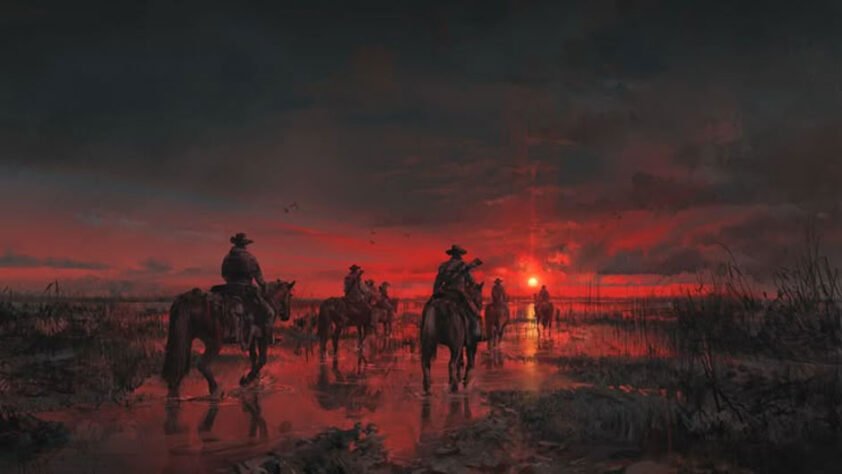
The phrase “The Evening Redness in the West” evokes a sunset, but one stained with the color of carnage. It is the twilight of the American frontier, where the romantic ideal is extinguished in a wash of blood, symbolizing the eternal, cyclical nature of violence.
Frequently Asked Questions
Is Blood Meridian based on a true story?
Is Blood Meridian based on a true story? (H3)
Yes, the novel is firmly grounded in historical fact. The Glanton Gang was a real group of American scalp hunters who operated in the borderlands of Texas and Mexico in the 1840s.
However, the character of Judge Holden is a massive, highly fictionalized figure. While a real Judge Holden was a member of the gang, McCarthy’s creation is an allegorical figure, a philosophical personification of war and evil.
Who is Judge Holden? (H3)
Judge Holden is the novel’s primary antagonist and its most profound symbol. He is a giant, hairless, and seemingly immortal figure who is a master of languages, science, and music.
He represents the intellectual and eternal justification for violence. He is the embodiment of the idea that war is not a necessary evil, but a divine, permanent, and essential part of the human experience.
What is the main theme of the book? (H3)
The main theme is the inherent and eternal nature of violence and war in the human condition. The novel rejects the idea of progress or moral evolution.
It posits that the capacity for pure, unmotivated evil is not an external force but an intrinsic part of human nature, a dark truth that the Judge both understands and celebrates.
Is Blood Meridian hard to read? (H3)
For many readers, yes, it is considered a challenging book. McCarthy’s prose is deliberately archaic, often lacking quotation marks to distinguish dialogue, and his vocabulary is vast and obscure.
More significantly, the relentless and graphic depiction of brutality can be emotionally taxing. It is a novel that demands patience and a willingness to confront uncomfortable truths.