
Was the man who walked the dusty roads of Judea truly God, or merely a created being of exceptional grace? This question, simple yet profound, threatened to tear the nascent Christian world apart in the early fourth century.
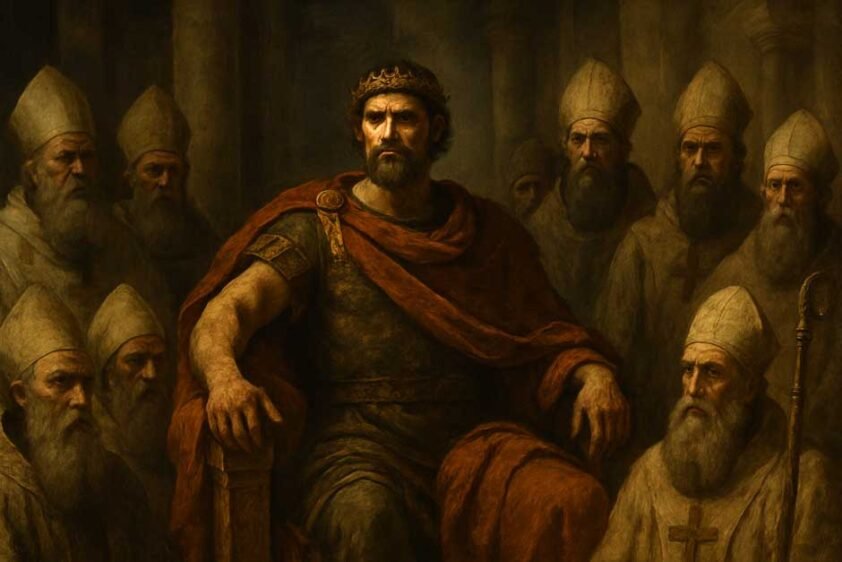
The answer would not come from a single prophet or theologian, but from a grand assembly of bishops, an event now known to history as the First Ecumenical Council of Nicaea.
This pivotal gathering in 325 AD was more than a religious conference; it was a political necessity that would forever shape the doctrine and structure of the Church.
The Imperial Call for Unity
A Divided Empire, A Divided Church
The Roman Empire had just been reunified under the sole rule of Emperor Constantine I. After years of civil war, the Emperor viewed a unified, stable Christian Church as a vital pillar for the stability of his vast realm.
He understood that religious concord was essential for the success of the state, and the escalating theological dispute was, for him, a matter of imperial security.
Division within the Church, he famously suggested, was worse than war itself, and he could not tolerate the discord that was spreading across the Eastern provinces.
The Rise of Arianism
The source of this great unrest was a respected presbyter from Alexandria named Arius. His doctrine, known as Arianism, proposed a radical idea: that the Son of God was not eternal, but was created by the Father from nothing.
Arius argued that “there was a time when he was not,” implying that Christ was a divine-like creature, but ultimately subordinate to God the Father.
This teaching gained widespread popularity, creating a schism that pitted bishop against bishop and threatened the very nature of Christian worship.
The Great Debate: A Matter of Substance
The Core Theological Conflict
The central conflict at Nicaea was a battle for the soul of Christian theology. On one side stood Arius, advocating for a strict monotheism that protected the Father’s absolute uniqueness.
On the other were Alexander of Alexandria and his brilliant deacon, Athanasius, who passionately defended the co-eternality and full divinity of Christ.
If Christ was merely a creature, then, according to Athanasius, humanity could not be truly saved by him. The debate hinged on whether Christ was divine in the same way the Father was divine, or in a lesser, secondary way.
Homoousios vs. Homoiousios
The entire controversy ultimately boiled down to a single Greek letter: the iota. The two opposing factions proposed terms to describe the relationship between the Father and the Son.
Arius’s supporters favored homoiousios, meaning “of a similar substance.”
The orthodox party insisted on homoousios, meaning “of the same substance.” The difference was minute in spelling but massive in theological implication.
Constantine, though not a theologian, understood the need for a definitive, unambiguous statement and ultimately threw his imperial weight behind the term homoousios.
The Birth of the Nicene Creed
Defining the Faith
The council, after intense and often acrimonious debate, overwhelmingly rejected Arianism. The result was a formal theological declaration that would become the first universal statement of Christian belief: the Nicene Creed.
This creed affirmed that Jesus Christ was “God from God, Light from Light, true God from true God, begotten, not made, of one substance with the Father.” By using the term homoousios, the bishops definitively established the full divinity and co-eternality of the Son.
The Condemnation of Arius
The few bishops who refused to sign the Creed, including Arius himself, were condemned and exiled by imperial decree. This act underscored the profound shift in the relationship between the Church and the Roman state, where theological decisions now carried the force of imperial law.
Beyond Doctrine: Other Key Decisions
The Date of Easter
While the Arian controversy dominated the proceedings, the council also addressed other pressing matters of ecclesiastical order. One significant decision was the establishment of a uniform method for calculating the date of Easter.
This was done to ensure that all Christians celebrated the resurrection of Christ on the same day, thereby fostering a sense of unity across the diverse Christian communities.
Establishing Church Law
In addition to the Creed, the council promulgated twenty canons, which served as the first universal laws of the Church. These canons addressed issues ranging from the ordination of clergy and the jurisdiction of bishops to the readmission of lapsed Christians.
These rules provided a necessary framework for the governance and discipline of the rapidly expanding Christian community.
The Enduring Legacy
A Foundation for Modern Christianity
The First Ecumenical Council of Nicaea remains one of the most important events in Christian history. The Nicene Creed, born from this tumultuous meeting, is still recited in churches across the globe, serving as a foundational statement of faith for Catholic, Orthodox, and many Protestant denominations.
The council set a crucial precedent: that the collective authority of the Church, gathered in an ecumenical council, could definitively resolve theological disputes.
The decisions made in the summer of 325 AD continue to define the core beliefs of billions of people, proving that a single word can indeed change the world forever.